






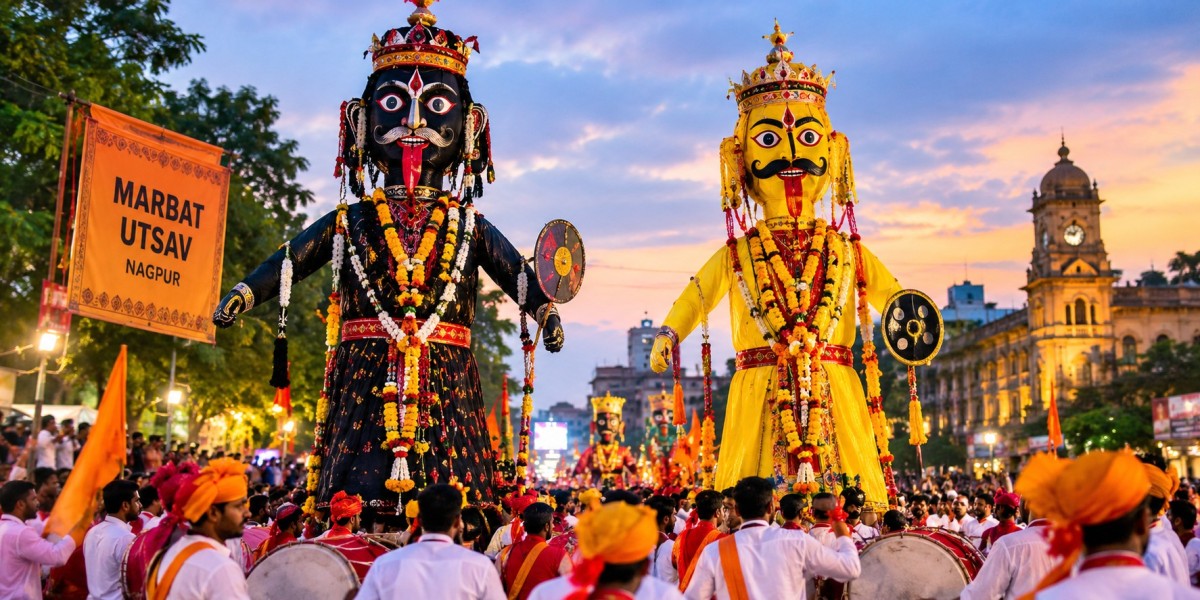
Nagpur’s Marbat Utsav is one of the city’s most distinctive cultural traditions. Every year, the festival brings thousands of people together for a colourful procession featuring the famous Kali Marbat, Peeli Marbat and Badgyas. More than a religious or cultural celebration, Marbat has become a unique way for people to express their concerns about social problems and symbolically drive away negativity. Maharashtra Tourism describes the festival as a blend of tradition, culture and social commentary dating back to the 19th century.
🪔 How Did the Marbat Utsav Tradition Begin?
The roots of Marbat go back to the colonial period. According to historical accounts, the tradition developed from an older practice in which people used symbolic figures to represent evil and negativity and later carried them in processions before destroying them.
The festival gradually developed into a major public tradition in Nagpur. Historical references place the beginning of the modern Marbat procession in the 1880s, with the tradition continuing for more than a century.
The festival is traditionally associated with Tanha Pola, celebrated after Pola. The Marbat effigies are carried through the streets, allowing people to participate in a collective ritual that represents the removal of evil and social problems.
Also Read: Brazilian Model Larissa Responds to Allegations of Rahul Gandhi’s Vote Chori Connection
⚫ What Is the Story Behind Kali Marbat?
The Kali Marbat, or Black Marbat, holds an important place in Nagpur’s history and folklore. It is traditionally associated with Queen Bakabai of the Bhonsle dynasty.
According to the popular historical narrative, Kali Marbat came to represent public anger over the queen’s association with British power. The symbolic figure therefore became a way for ordinary people to express their resentment and criticism during the colonial period.
Over the years, Kali Marbat has retained its importance in the annual procession. For Nagpur residents, it represents not only an old historical memory but also the festival’s long-standing tradition of giving people a symbolic voice.
🟡 Why Is Peeli Marbat Utsav Celebrated?
The Peeli Marbat, or Yellow Marbat, carries a different historical symbolism. It has traditionally been associated with British rule, epidemics and other forms of suffering faced by society.
The yellow effigy became another symbolic representation of negativity that people wanted to remove from their lives. Historical accounts also connect the Peeli Marbat with public concerns about disease and social difficulties.
The combination of Kali and Peeli Marbat gives the festival its distinctive identity. Both effigies represent different forms of negativity, but the underlying message remains the same — people want to leave behind suffering and move towards a better future.
🥁 What Happens During the Marbat Procession?
The Marbat celebrations turn several parts of Nagpur into a vibrant cultural space. Large effigies are carried through the streets in a procession accompanied by dhols, music, slogans, cultural performances and large crowds.
The procession traditionally passes through parts of eastern and central Nagpur before reaching its concluding point. Government tourism information notes that the procession has historically covered a route of around 10 kilometres.
People also create Badgyas, or symbolic mascots, representing contemporary problems. These figures can highlight issues affecting ordinary people, giving the festival a strong element of social commentary.
🎭 Marbat as a Voice Against Social Problems
One of the most fascinating aspects of Marbat Utsav is its ability to combine tradition with contemporary issues.
Every year, organisers and communities can use symbolic figures to comment on problems such as corruption, inflation, injustice, addiction and other social concerns. This has helped Marbat remain relevant even as society has changed.
In this way, the festival does more than preserve history. It gives people an informal platform to express public sentiment through art, satire and symbolism.
✨ Kali and Peeli Marbat Remain at the Heart of the Festival
For generations, the Kali and Peeli Marbats have remained the central symbols of Nagpur’s Marbat tradition. The festival continues to attract residents and visitors because of its unique combination of history, folk culture, public participation and social messaging.
In 2026, organisers have also introduced a 13-foot Silver Marbat in Imambada. The new effigy does not replace Kali or Peeli Marbat. Organisers have described it as an additional symbol, with its silver/white appearance representing peace, unity and harmony.
🌿 Why Marbat Utsav Still Matters Today
Marbat Utsav has survived for more than a century because it continues to connect Nagpur’s past with its present. The festival preserves an old cultural tradition while allowing every generation to express its own concerns.
Its message is simple but powerful: identify negativity, stand together against it and hope for a better society. The colourful procession, traditional music and symbolic effigies make Marbat one of Nagpur’s most recognisable cultural traditions.
🏁 Conclusion
Marbat Utsav 2026 is much more than a procession of giant effigies. The stories of Kali Marbat and Peeli Marbat connect Nagpur’s present-day celebrations with its colonial-era history, folk traditions and public expressions of social concerns.
As the city continues to celebrate this historic tradition, Marbat remains a powerful symbol of community, cultural identity and the triumph of good over negativity. For Nagpur, it is not simply a festival — it is a living piece of the city’s heritage.