






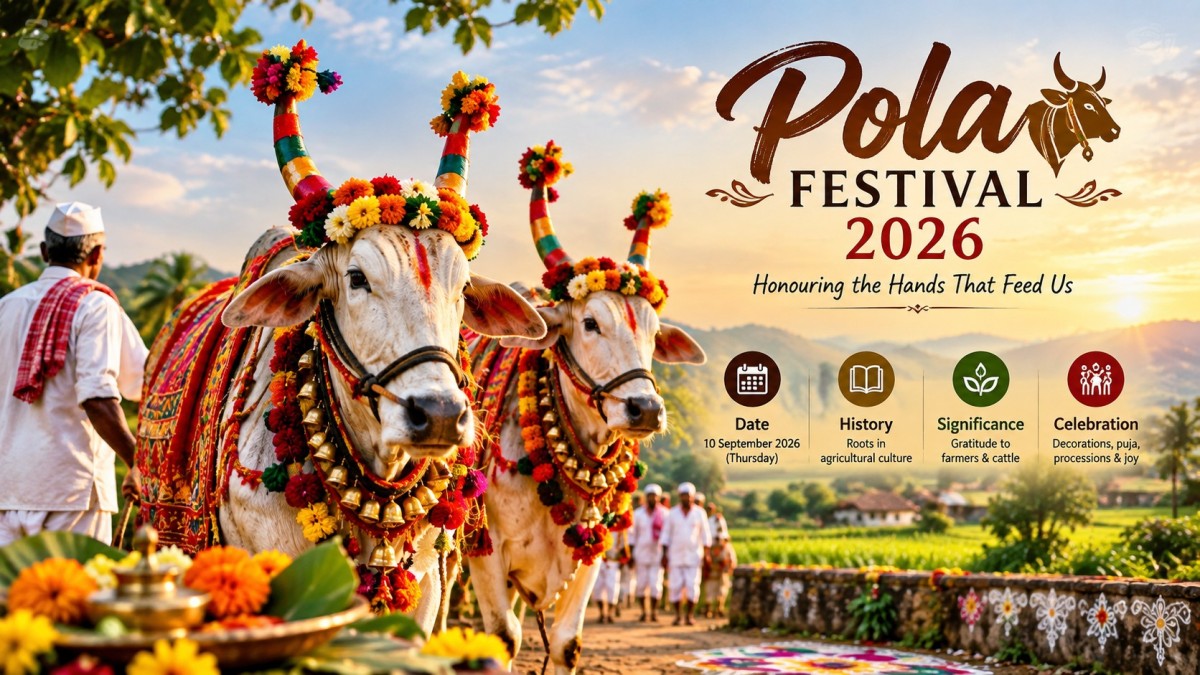
Pola Festival, also known as Bail Pola, is an important agricultural festival in Maharashtra. Farmers celebrate this special occasion to honour bulls and bullocks for their contribution to farming. Moreover, the festival highlights the strong relationship between farmers, animals and nature.
Every year, families and farming communities celebrate Pola with traditional rituals, colourful decorations, festive food and village processions. Therefore, the festival remains an important part of Maharashtra’s rural culture.
📅 Pola Festival 2026 Date
In 2026, Pola Festival will be celebrated on 10 September in Maharashtra. The festival falls on Shravan Amavasya, the new moon day of the Shravan month.
Traditionally, farmers choose this day to give their cattle a break from agricultural work. In addition, they express their gratitude for the important role that bullocks play in farming.
🌾 What is Pola Festival?
Pola is a traditional festival dedicated mainly to bullocks and cattle used in agriculture. In earlier times, farmers depended heavily on bullocks for ploughing fields, transporting materials and performing other farming activities.
Therefore, Pola gives farmers an opportunity to thank these animals for their hard work. At the same time, the festival celebrates the importance of agriculture in rural life.
Although modern machinery has changed farming practices, many communities continue to celebrate Pola with the same enthusiasm.
📖 History of Pola Festival
Pola has deep roots in Maharashtra’s agricultural traditions. For generations, farmers have considered cattle an important part of their livelihood and household.
According to a popular traditional belief, Lord Krishna defeated the demon Polasur on this day. As a result, the festival also carries a mythological connection.
Furthermore, the festival takes place during the monsoon season, an important period for farmers. Consequently, Pola connects religious traditions with the agricultural calendar.
🙏 Significance of Pola Festival
The main purpose of Pola is to show gratitude toward bullocks and other cattle. Farmers recognise the animals’ contribution to their agricultural work and give them a day of rest.
In addition, the festival promotes:
- 🐂 Respect for animals
- 🌾 Appreciation for farmers
- 🌱 Connection with nature
- ❤️ Gratitude and compassion
- 🤝 Community unity
- 🪔 Preservation of traditions
Thus, Pola represents much more than a religious celebration. It also reflects the values of respect, gratitude and harmony with nature.
🐂 How is Pola Festival Celebrated?
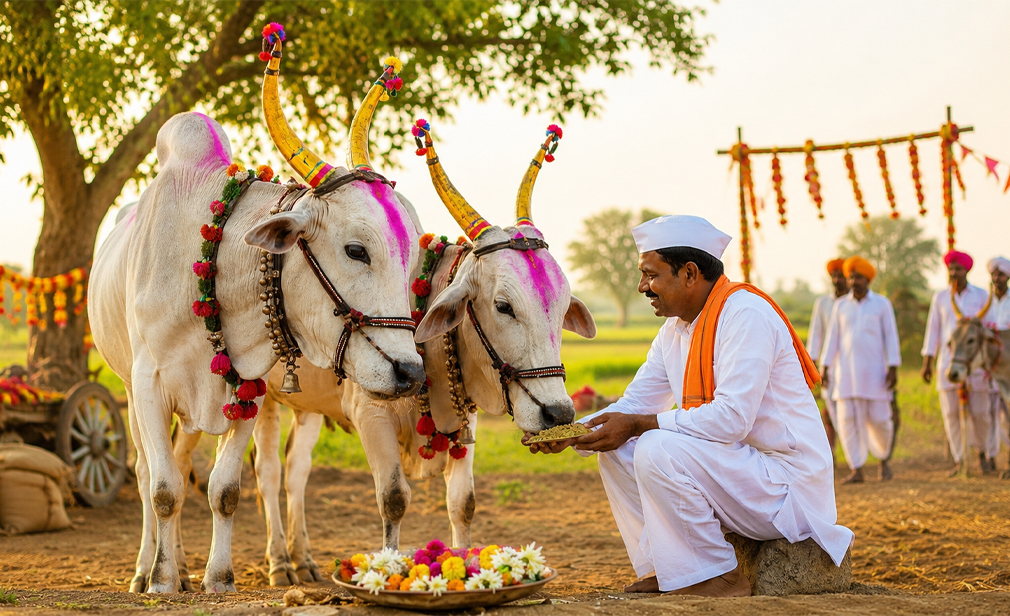
Farmers usually begin preparations several days before the festival. First, they clean their cattle and prepare colourful decorations. Then, on the festival day, they give their bullocks a bath and decorate them for the celebrations.
Farmers traditionally:
- 🛁 Bathe and clean their bullocks
- 💆 Give them an oil massage
- 🌸 Decorate them with flowers and ribbons
- 🔔 Place colourful bells around their necks
- 🟥 Apply turmeric and vermilion
- 🧣 Dress them in colourful cloth
- 🙏 Perform puja and aarti
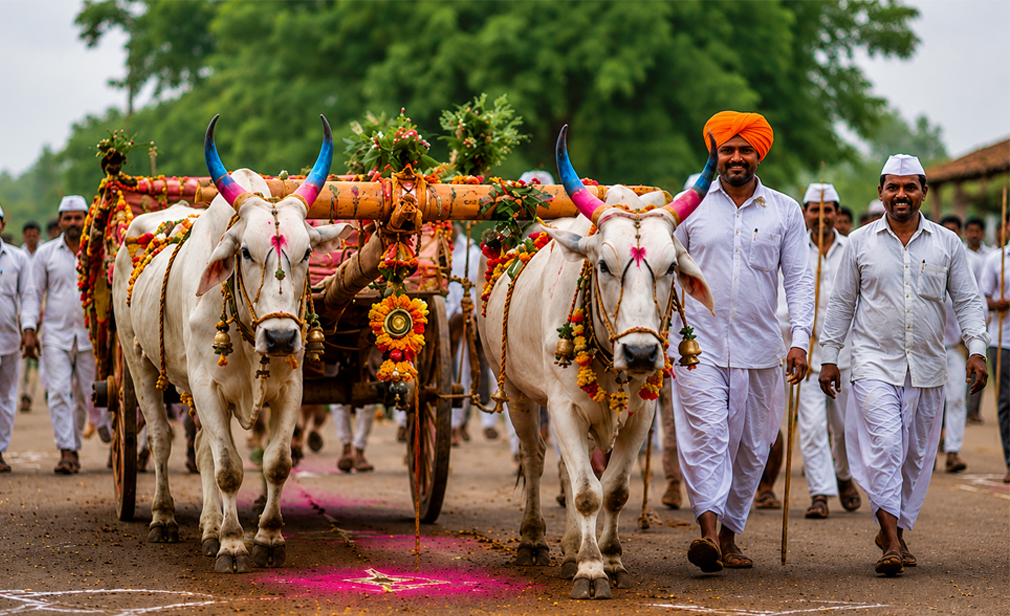
After the rituals, farmers may take the decorated bullocks through village streets. Meanwhile, drums, dhols and traditional music create a festive atmosphere.
🏡 Pola Traditions at Home
Pola also brings families together at home. Before the celebration begins, families clean their houses and decorate entrances with rangoli and torans.
In addition, families prepare puja thalis and light traditional lamps. Children often take part in the celebrations by making small wooden bullock figures.
As a result, Pola becomes a family occasion as well as an agricultural festival.
🍽️ Traditional Food During Pola
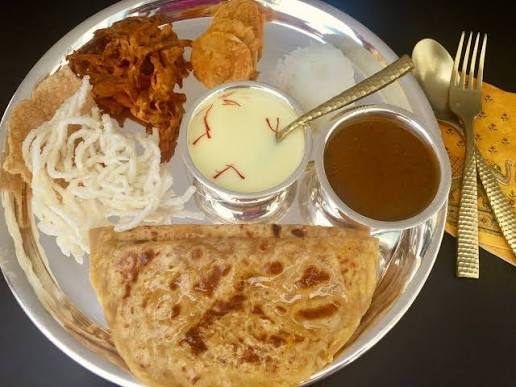
Food plays an important role in Pola celebrations. Families prepare traditional Maharashtrian dishes and enjoy festive meals together.
Some popular dishes include:
- 🥞 Puran Poli
- 🌾 Bhakri
- 🥘 Vegetable curry
- 🍚 Sheera
In particular, Puran Poli remains one of the popular festive dishes associated with Bail Pola.
🥁 Village Processions and Celebrations
One of the biggest attractions of Pola is the traditional village procession. Farmers bring their decorated bullocks together, creating a colourful and lively scene.
Furthermore, villagers gather to enjoy traditional music, dancing and community activities. These processions also give younger generations an opportunity to learn about local customs.
Therefore, Pola helps communities preserve their cultural identity while bringing people together.
🌱 Pola and Agriculture
Agriculture remains at the heart of Pola. Historically, bullocks helped farmers plough fields, transport goods and complete several farming tasks.
Today, tractors and other machines perform many of these activities. However, farmers continue to celebrate Pola because the festival represents their respect for traditional farming and livestock.
In this way, Pola keeps an important connection between agriculture, animals and rural communities alive.
🛕 Religious and Cultural Importance
Animals hold an important place in Indian traditions. For example, Hindu traditions associate Nandi, Lord Shiva’s bull, with devotion and religious significance.
Similarly, Pola reflects the cultural respect that farming communities have for cattle. Therefore, the festival combines agricultural traditions with religious and cultural beliefs.
🗺️ Where is Pola Festival Celebrated?
Maharashtra celebrates Pola on a large scale, particularly in rural farming communities. However, people also observe similar traditions in Madhya Pradesh, Chhattisgarh, Karnataka and Telangana.
Each region may follow slightly different customs. Nevertheless, the central idea remains the same: people express gratitude toward cattle and celebrate their contribution to rural life.
🏙️ Pola Festival in Nagpur
Pola has a special cultural connection with Nagpur and the Vidarbha region. In addition, Nagpur hosts the distinctive Marbat Utsav, which takes place on the second day of Pola.
The event features colourful processions and traditional effigies. Moreover, Marbat Utsav has developed into a platform for social and cultural expression in Nagpur.
🌿 Pola Festival in Modern Times
Modern technology has reduced farmers’ dependence on bullocks in many parts of India. However, Pola continues to preserve the emotional and cultural connection between farmers and their animals.
Furthermore, the festival teaches younger generations about traditional farming practices and the importance of caring for animals.
As a result, Pola continues to remain relevant even as rural life changes.
❤️ Why is Pola Festival Still Important?
Pola carries an important message of gratitude and respect. Farmers take time to recognise the animals that have supported agricultural work for generations.
Moreover, the festival brings families and communities together. Through traditional food, music, rituals and processions, people celebrate their shared heritage.
Therefore, Pola is not only an agricultural festival but also a celebration of Maharashtra’s culture and rural identity.
🎉 Conclusion
Pola Festival 2026 will be celebrated on 10 September 2026 in Maharashtra. The festival honours bullocks, celebrates farmers and highlights the importance of agriculture in rural communities.
From colourful decorations and traditional puja to village processions and festive food, Pola offers a unique combination of culture, tradition and community spirit. Ultimately, the festival reminds us to respect animals, appreciate farmers and preserve our cultural heritage for future generations.