









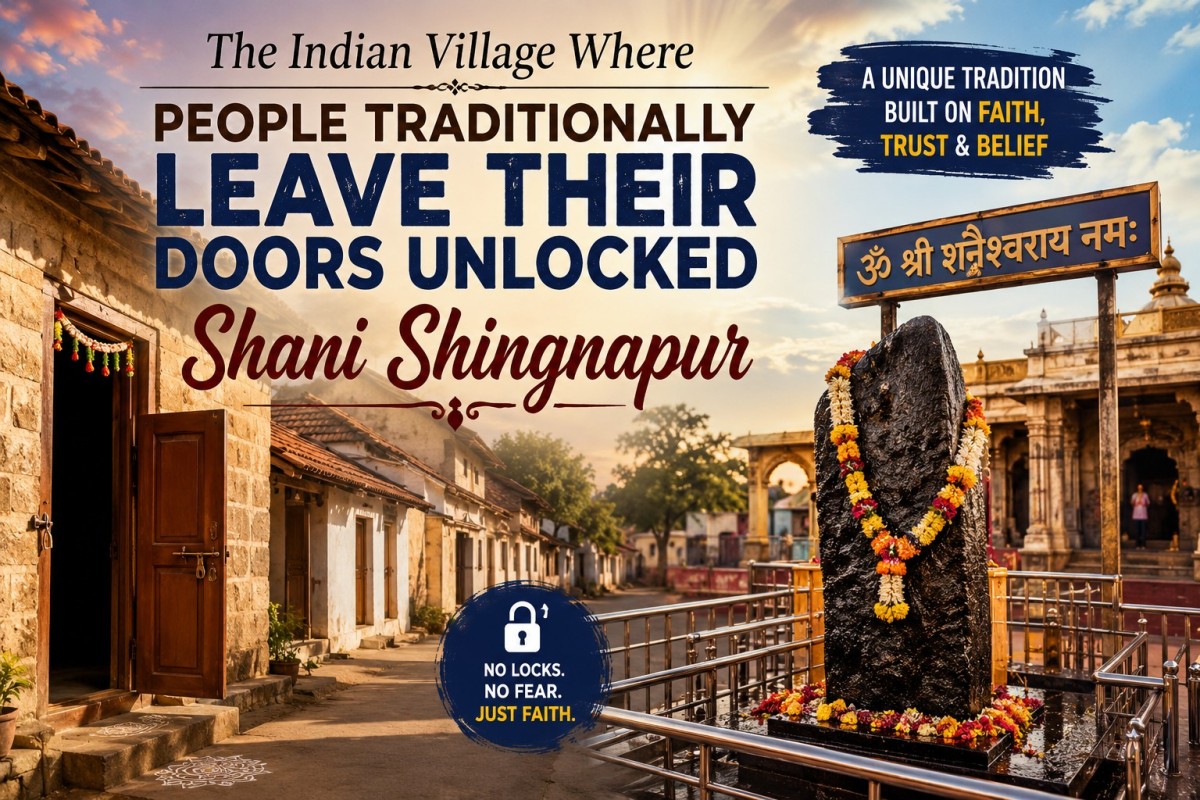
🚪✨ Imagine Living Without a Lock on Your Door
Imagine leaving home in the morning without turning a key.
Imagine leaving home in the morning without worrying about locking the door or activating any security system.
For most people, that sounds impossible. Yet in Shani Shingnapur, a village in Maharashtra, a remarkable tradition has made the place famous across India. 🇮🇳
For most people, that sounds impossible. Yet in Shani Shingnapur, a village in Maharashtra, a remarkable tradition has made the place famous across India. 🇮🇳
For generations, many residents have traditionally kept their homes and shops without conventional locks, relying instead on their strong faith in Lord Shani, the Hindu deity associated with Saturn, justice and karma.
But the story behind this unusual custom is far more interesting than the simple claim that “nobody locks their doors.”
🛕🖤 The Sacred Stone at the Heart of the Village
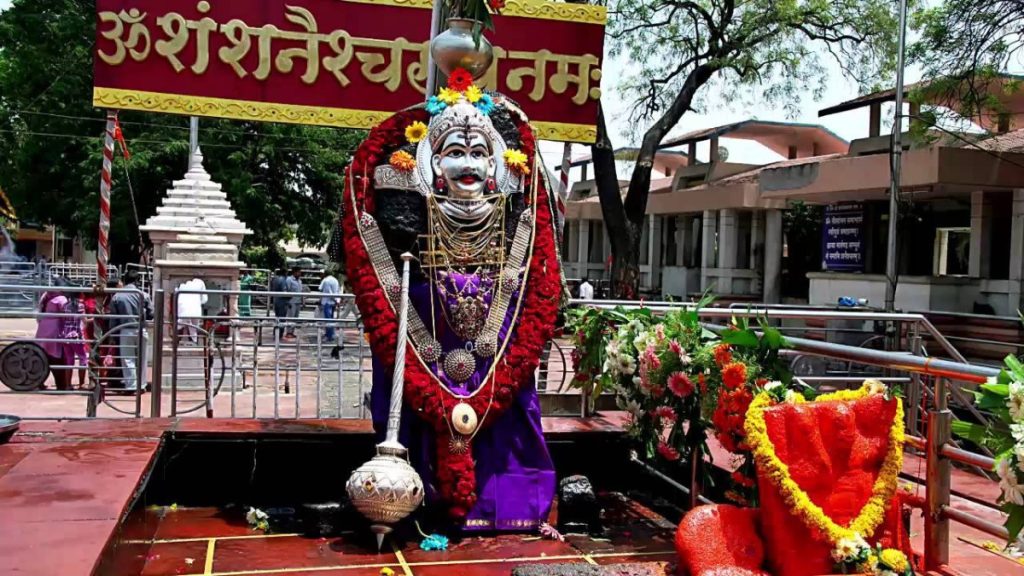
At the centre of Shani Shingnapur’s spiritual identity is a black stone believed by devotees to be a self-manifested form of Lord Shani.
According to local tradition, the stone appeared in the village long ago after being discovered by a shepherd. The story says that when the stone was touched with a sharp object, blood appeared from it.
The villagers interpreted the mysterious event as a divine sign.
A shrine was eventually established around the sacred stone, and Lord Shani became deeply connected with the village’s identity. 🙏
Over time, a powerful belief developed among devotees: those who steal or commit wrongdoing will face Lord Shani’s justice.
This belief became closely connected with the village’s unusual approach to security.
🔓🏠 Why Don’t People Use Locks?
The tradition is based largely on faith rather than a formal rule.
Many residents believe that stealing from another person would invite the consequences of Lord Shani’s displeasure. Because of this belief, the need for traditional locks was historically seen as unnecessary.
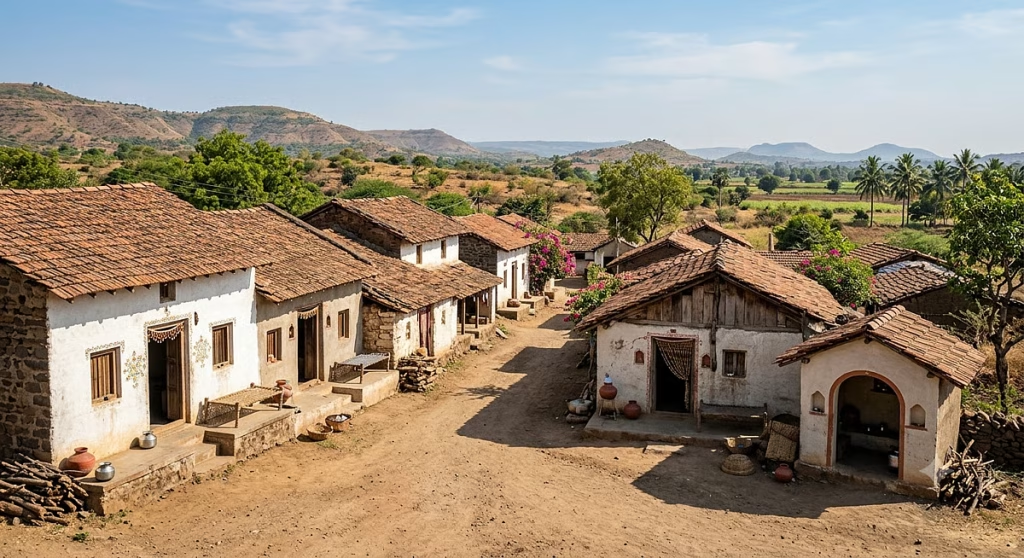
Some homes were built with open entrances rather than conventional doors, while shops and other establishments also became associated with the no-lock tradition.
For residents, the custom isn’t simply about avoiding a padlock. It represents trust, devotion and the belief that divine justice cannot be escaped.
👀📸 A Mystery That Attracts Visitors
The unusual tradition has made Shani Shingnapur a popular destination for curious visitors.
People arrive not only to pray at the temple but also to experience a village whose reputation is so different from ordinary urban life.
For someone accustomed to CCTV cameras, security guards, passwords and smart locks, seeing homes associated with an old no-lock tradition can feel almost unreal.
And that’s what makes the village so fascinating: the most unusual thing isn’t what people have—it’s what they traditionally choose not to use.
🏦🔐 Is It Really True That Nobody Locks Anything?
This is where the popular story needs some context.
The phrase “the village where nobody locks their doors” has become famous, but reality is more nuanced.
Shani Shingnapur has changed with time. Modern buildings, businesses and changing lifestyles mean that the traditional practice is not absolute. Some residents and establishments use modern security measures.
So it would be misleading to imagine an entire modern village where every single house is permanently open and completely unsecured.
The fascinating part is the continuing cultural memory and religious tradition behind the practice.
⚖️🙏 A Village Built Around the Idea of Karma
Lord Shani occupies a special place in Hindu belief.
He is commonly associated with karma, discipline and justice—the idea that a person’s actions eventually have consequences.
That makes the story of Shani Shingnapur particularly powerful.
The village’s traditional approach to security reflects a simple philosophy:
If you believe that every action has consequences, why risk committing a wrong in the first place?
For devotees, divine justice is considered more powerful than any physical lock.
🌆🔒 A Fascinating Contrast With Modern India
There is something almost poetic about Shani Shingnapur.
India has some of the world’s fastest-growing cities, sophisticated technology, digital payments, surveillance systems and smart homes.
Yet in one village, an ancient belief continues to influence something as ordinary as how people protect their homes.
It creates a striking contrast.
Modern security says: 🔐 Protect your belongings with technology.
The traditional belief says: 🙏 Live honestly, and divine justice will protect you.
🧠✨ The Bigger Story Behind the Lock
The real story of Shani Shingnapur isn’t simply about doors.
It’s about how deeply culture and belief can influence everyday behaviour.
A lock is normally a physical object. It protects a house because we don’t necessarily trust everyone outside it.
But Shani Shingnapur’s tradition represents another kind of security—one based on faith, community values and fear of moral consequences.
Whether you see it as spirituality, tradition or simply a fascinating social custom, the idea is extraordinary.
🇮🇳❤️ One More Reason India Is Full of Surprises
India is home to thousands of communities, each with its own customs, beliefs and stories.
Some traditions are centuries old. Others are slowly changing with modern life.
Shani Shingnapur stands out because an everyday object that most of us barely think about—a door lock—became part of an entire village’s identity.
🔐 In most places, a lock says: “Keep out.”
🙏 In Shani Shingnapur’s traditional story, an unlocked door says: “We trust in something greater.”
And perhaps that’s what makes this Maharashtra village one of India’s most intriguing cultural stories. 🇮🇳✨
Also Read : 15 Inspiring Independence Day Quotes by India’s Freedom Fighters