









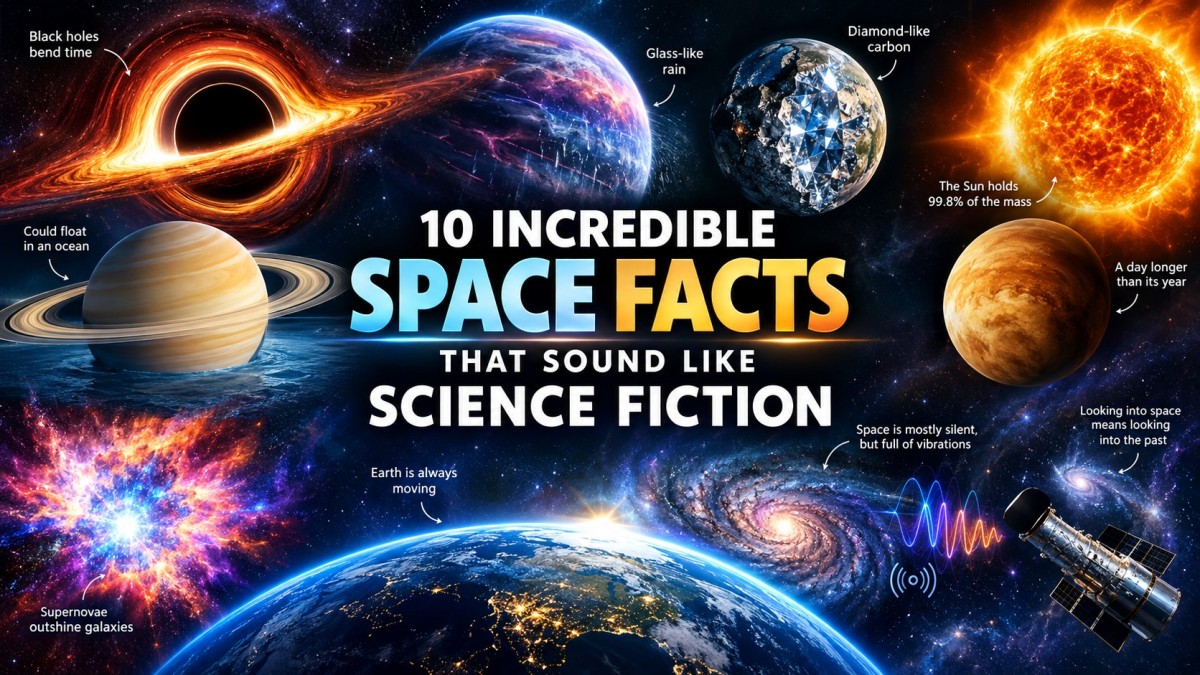
The universe is filled with objects and phenomena that can sound like scenes from a science-fiction movie. From planets with extreme weather to black holes that distort space and time, scientists continue to uncover remarkable facts about the cosmos. Here are 10 incredible space facts that show just how strange and fascinating our universe can be.
🕳️ 1. Black Holes Can Distort Time
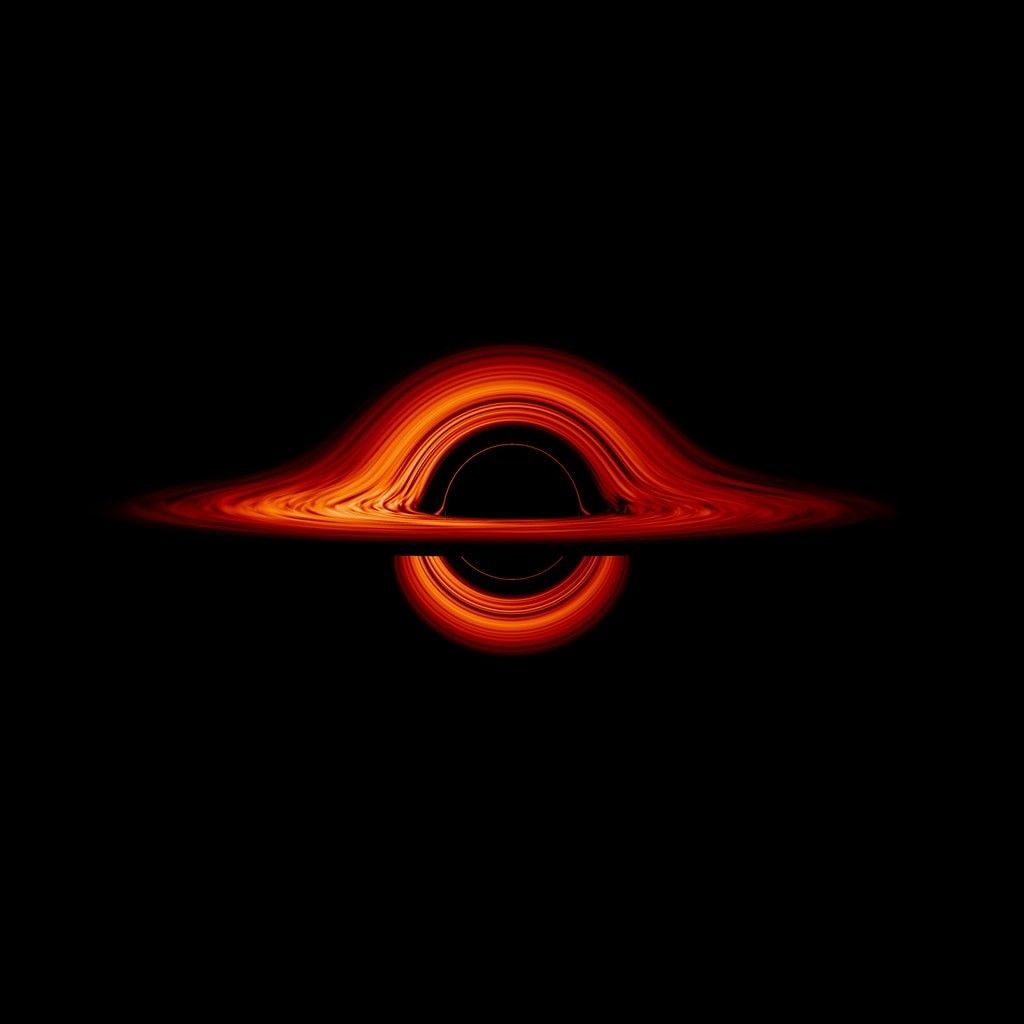
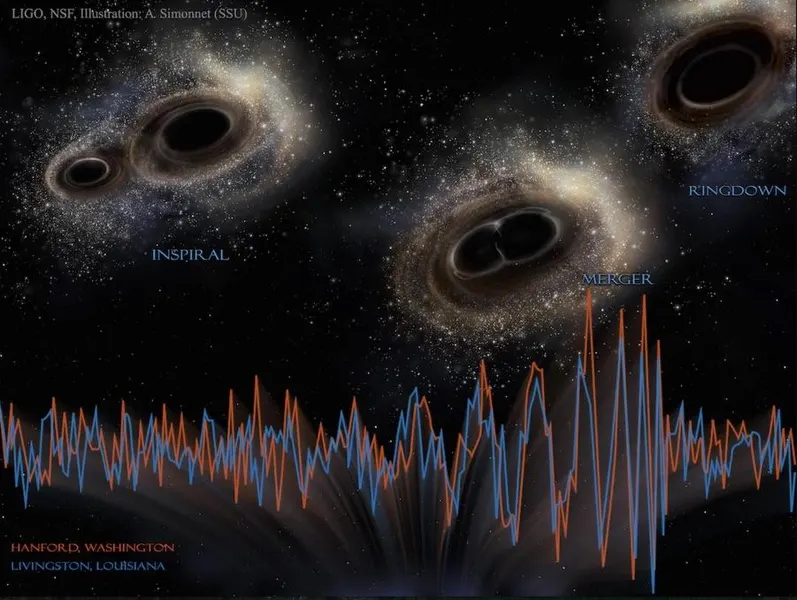
Black holes have gravity so powerful that they dramatically curve spacetime around them. According to Einstein’s theory of relativity, time passes differently in regions with extremely strong gravity.
For someone watching from far away, an object approaching a black hole would appear to move increasingly slowly as it gets closer to the event horizon. This strange effect is known as gravitational time dilation.
🌧️ 2. Some Planets May Have Glass-Like Rain
The exoplanet HD 189733 b is famous for its incredibly extreme environment. Scientists have found evidence of silicate particles in its atmosphere, which could form glass-like clouds.
The planet also experiences powerful winds that may reach several thousand miles per hour. Under such conditions, scientists believe tiny glass particles could potentially be blown sideways through the atmosphere rather than falling straight down.
💎 3. Some Worlds Could Contain Diamond-Like Carbon
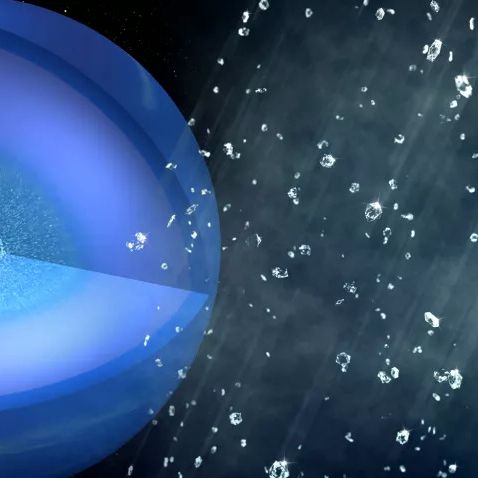
Scientists have proposed that some carbon-rich planets may contain materials formed under enormous pressure. Extreme conditions deep inside such worlds could transform carbon into diamond-like structures.
One frequently discussed example is the exoplanet 55 Cancri e, although its exact composition remains an active area of scientific study. Researchers continue using observations to determine what these distant worlds are really made of.
☀️ 4. The Sun Contains Almost All the Solar System’s Mass
The Sun is vastly larger than every planet, moon, asteroid and comet in our solar system combined. It contains roughly 99.8% of the solar system’s total mass.
Its immense gravity controls the movement of planets and countless smaller objects. Without the Sun’s gravitational influence, the solar system would look completely different.
🪐 5. A Day on Venus Is Longer Than Its Year
Venus rotates incredibly slowly compared with Earth. One complete rotation takes about 243 Earth days, while Venus takes roughly 225 Earth days to orbit the Sun.
This means a Venusian day, measured by one full rotation relative to distant stars, lasts longer than its year. Venus also rotates in the opposite direction to most planets in our solar system.
💧 6. Saturn Could Float in a Hypothetical Ocean
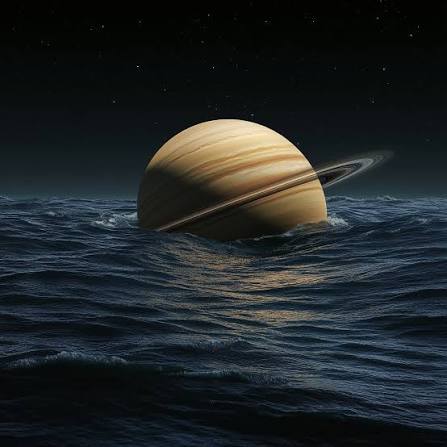
Saturn is famous for its spectacular ring system, but its average density is also unusual. It is less dense than water, with an average density of about 0.69 grams per cubic centimetre.
If an imaginary ocean were large enough to contain Saturn without being destroyed by the planet’s gravity, Saturn would theoretically float. Such an ocean does not exist, making this a fascinating thought experiment rather than something that could happen in reality.
💥 7. Supernovae Can Outshine Entire Galaxies
When certain massive stars reach the end of their lives, they can explode in spectacular events called supernovae. For a short period, a supernova can release an enormous amount of energy.
These explosions also play an important role in the universe. They help distribute heavy elements into space, contributing to the material that can eventually form new stars, planets and other cosmic objects.
🚀 8. Earth Is Constantly Racing Through Space
We may feel stationary while standing on Earth, but our planet is moving at tremendous speeds. Earth rotates on its axis, travels around the Sun and moves with the solar system through the Milky Way.
The Milky Way itself is also moving through space. This means that every moment of our lives takes place while Earth and our entire cosmic neighbourhood are in constant motion.
🔊 9. Space Is Mostly Silent, but It Contains Vibrations
In the vacuum of space, ordinary sound waves cannot travel because there is not enough matter to carry them. However, space is filled with electromagnetic waves, plasma and other signals that scientific instruments can detect.
Scientists can convert some of these signals into audio frequencies. The resulting sounds allow researchers and the public to experience data from otherwise invisible cosmic phenomena.
🔭 10. Looking Into Space Means Looking Into the Past
Light does not travel instantaneously. Because it takes time to cross enormous cosmic distances, telescopes see distant objects as they appeared when their light began its journey.
For example, when astronomers observe a galaxy millions of light-years away, they are seeing it as it existed millions of years ago. Powerful space telescopes can therefore act like natural time machines, allowing scientists to study different stages of cosmic history.
🌌 The Universe Still Holds Countless Mysteries
These facts represent only a small part of what makes space so fascinating. Every new telescope, spacecraft and scientific mission gives researchers another opportunity to understand the universe.
From the extreme gravity of black holes to the strange atmospheres of distant exoplanets, the cosmos continues to challenge our understanding. The more scientists discover, the more questions emerge about what lies beyond our own corner of space.