










Introduction
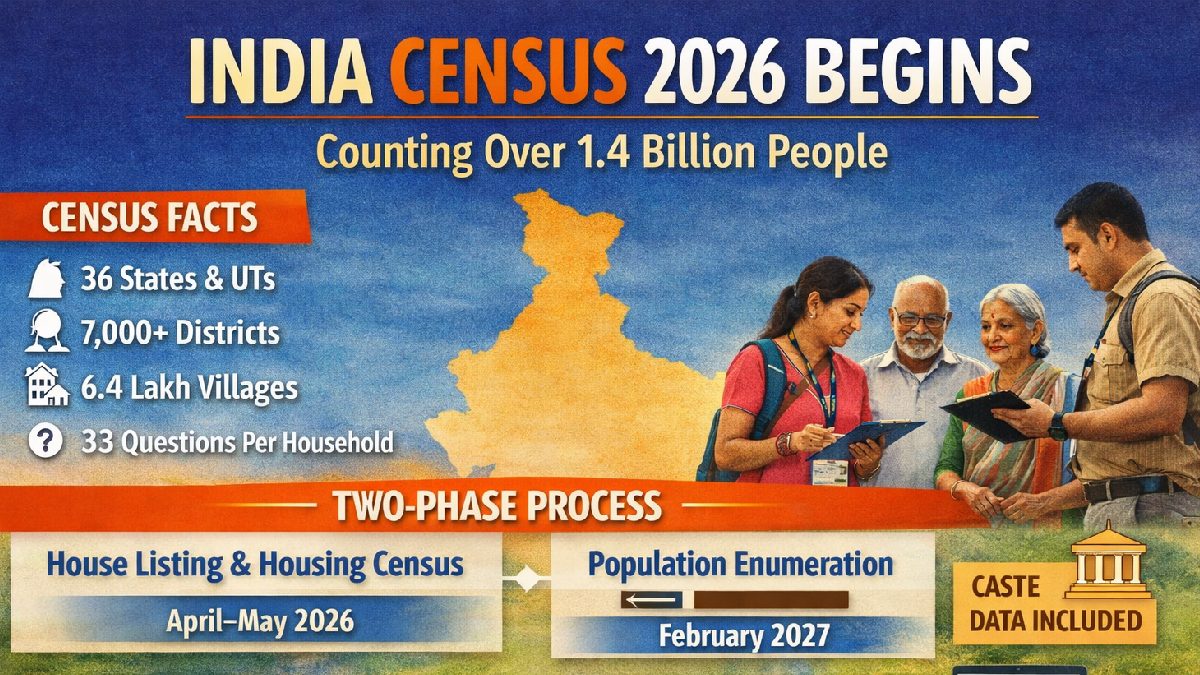
Census 2026 marks a crucial milestone in India’s journey toward planned and inclusive development. The government has initiated this nationwide exercise to collect accurate and comprehensive data about the population. By conducting the census, authorities aim to understand demographic trends, economic conditions, and social changes. This data will directly support better decision-making and policy planning across sectors.
Also Read: Brazilian Model Larissa Responds to Allegations of Rahul Gandhi’s Vote Chori Connection
What is Census 2026?
Census 2026 is a large-scale population survey that the government conducts to gather detailed information about every individual living in the country. Officials and enumerators visit households, collect data, and record details such as age, gender, occupation, education, and living conditions. The government uses this data to create a reliable database that reflects the country’s current status.
Objectives of Census 2026
The census focuses on several key objectives:
- It collects accurate population data for effective governance.
- It helps the government plan infrastructure such as schools, hospitals, and transportation.
- It identifies socio-economic gaps and supports welfare schemes.
- It assists in fair distribution of resources among states and regions.
By achieving these objectives, the census strengthens the foundation for long-term development.
Role in Data-Driven Development
Census 2026 plays a vital role in promoting data-driven development. Policymakers rely on factual data instead of assumptions while designing policies. For example, if the data shows a rise in population in urban areas, the government can expand housing and transport facilities accordingly.
Similarly, education and healthcare sectors benefit from accurate data. Authorities can build more schools in regions with higher child populations and improve hospitals where healthcare demand is rising. This approach ensures efficient use of resources and better outcomes.
Use of Technology in Census 2026
The government has introduced modern technology to improve the accuracy and speed of the census process. Enumerators now use digital devices to collect and upload data in real time. This reduces errors, speeds up processing, and ensures better data security.
Online self-enumeration options also allow citizens to submit their details conveniently. This digital transformation makes Census 2026 faster, more reliable, and transparent.
Challenges in Census Counting
Despite its importance, Census 2026 faces several challenges:
- Reaching remote and rural areas remains difficult.
- Some citizens may hesitate to share personal information.
- Managing such a large-scale operation requires strong coordination.
However, with proper planning and awareness campaigns, authorities can overcome these challenges.
Importance for the Future
Census data shapes the future of the nation. It helps in urban planning, employment generation, poverty reduction, and social welfare programs. Governments, researchers, and businesses use this data to make informed decisions that impact millions of lives.
Accurate census data also strengthens democracy by ensuring fair representation and policy transparency.
Conclusion
Census 2026 serves as a powerful tool for nation-building. It enables the government to base its decisions on real data and address the needs of the population effectively. By actively participating in the census, citizens contribute to the country’s progress. With accurate data and modern technology, Census 2026 truly paves the way for data-driven development and a better future for all.
Also Read: NCERT apologises to Supreme Court withdraws Class 8 textbook after controversy