







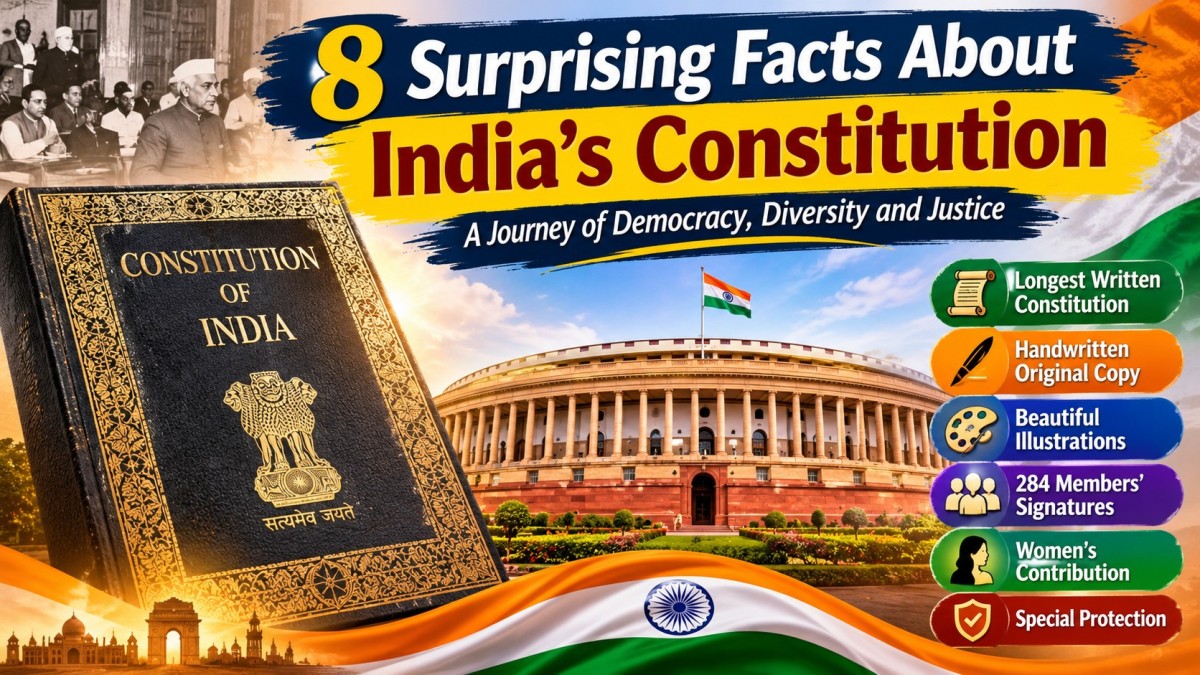
India’s Constitution is much more than a legal document. It represents the country’s democratic values, historical struggles, cultural diversity and vision for the future. It establishes how the government functions and protects the fundamental rights of citizens. The Constituent Assembly adopted the Constitution on November 26, 1949, and it came into effect on January 26, 1950. Every year, India celebrates November 26 as Constitution Day and January 26 as Republic Day. Here are eight fascinating facts about this historic document that every Indian should know.
📜 1. India Has One of the World’s Longest Written Constitutions
India has one of the world’s longest and most detailed written constitutions. When it came into force in 1950, it contained 395 Articles, 22 Parts and eight Schedules. Over the years, Parliament has introduced several constitutional amendments to address changing national needs.
The Constitution covers several important subjects, including fundamental rights, citizenship, elections, government institutions, relations between the Centre and states, and the judiciary. Its detailed structure helps explain how the world’s largest democracy operates. The document also reflects India’s diverse population, languages, cultures and regional interests.
✍️ 2. The Original Constitution Was Handwritten
One of the most fascinating facts about India’s Constitution is that its original copies were handwritten rather than printed or typed. Calligrapher Prem Behari Narain Raizada wrote the English version in an elegant flowing script.
The original Hindi version was also handwritten. Raizada reportedly completed the work without accepting payment, asking only for his name to appear on the document. His contribution made the original Constitution a remarkable example of calligraphy and craftsmanship.
These handwritten manuscripts remain important historical treasures. They remind us that the Constitution represents not only legal thinking but also the dedication and artistic skills of several individuals.
🎨 3. Artists Decorated the Original Constitution
India’s original Constitution contains beautiful illustrations that make it different from ordinary legal documents. Artists from Santiniketan created these illustrations under the guidance of renowned artist Acharya Nandalal Bose.
The artwork represents different periods of Indian history and civilisation. It includes scenes associated with the Indus Valley Civilisation, the Vedic period, the Ramayana, the Mahabharata, ancient kingdoms and India’s freedom struggle.
These illustrations give the Constitution a distinctive cultural identity. They connect India’s ancient heritage with its modern democratic values. The artwork also reflects the country’s artistic traditions and historical diversity.
⏳ 4. Drafting the Constitution Took Almost Three Years
The Constituent Assembly took two years, 11 months and 18 days to prepare India’s Constitution. Its members began their work on December 9, 1946, before India achieved independence.
The Assembly discussed different provisions, examined proposals and debated important questions about India’s political future. Members considered subjects such as fundamental rights, minority protections, federalism and the powers of government institutions.
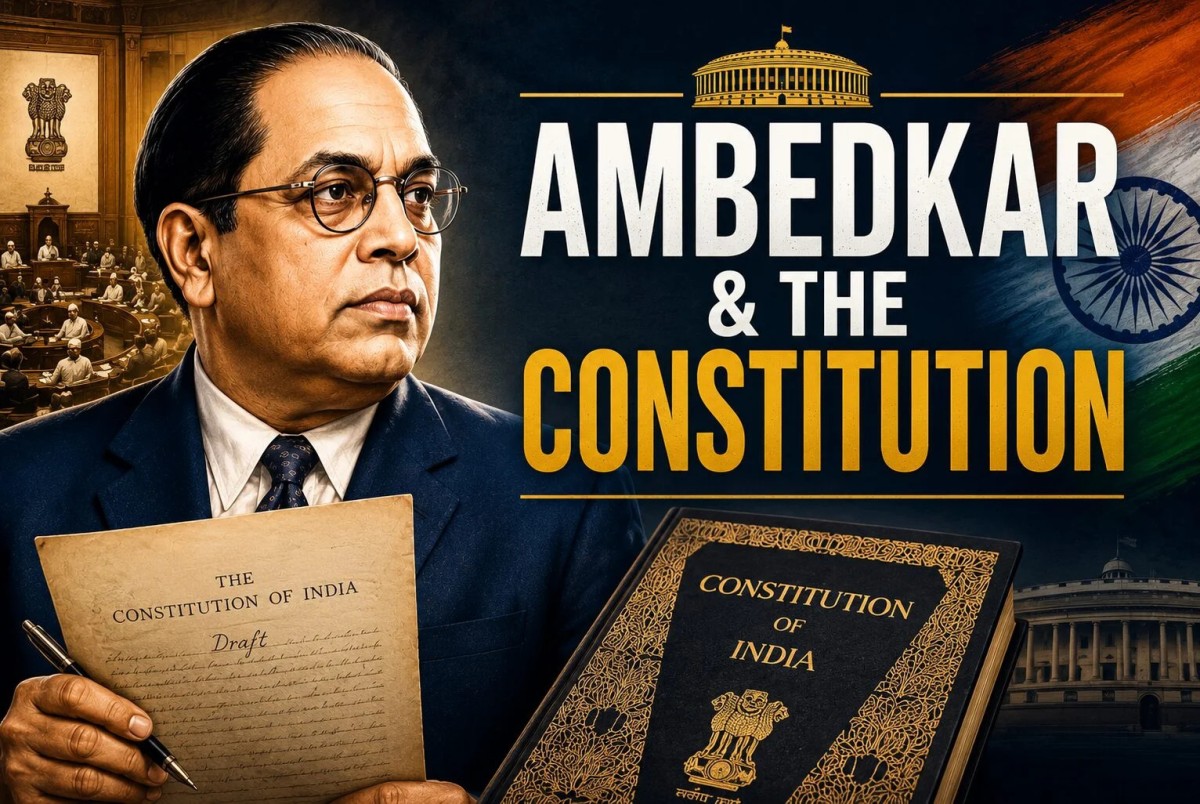
Dr. B. R. Ambedkar chaired the Drafting Committee, which played a central role in preparing the document. His contribution earned him recognition as the chief architect of the Indian Constitution. The extensive discussions helped create a framework suited to India’s unique circumstances.
👥 5. A Total of 284 Members Signed the Constitution
On January 24, 1950, a total of 284 members of the Constituent Assembly signed the Constitution. This historic event took place shortly before India officially became a republic.
The members included representatives from different regions, communities and backgrounds. Their participation reflected the Assembly’s effort to build a constitutional framework for an independent and diverse nation.
The Constitution came into effect on January 26, 1950. India chose this date to honour the declaration of Purna Swaraj, or complete independence, adopted by the Indian National Congress in 1930.
👩 6. Women Also Helped Shape the Constitution
Women played an important role in the making of India’s Constitution. Fifteen women served as members of the Constituent Assembly and contributed to discussions about the country’s future.
Some prominent women members included Sarojini Naidu, Hansa Mehta, Durgabai Deshmukh, Rajkumari Amrit Kaur and Sucheta Kripalani. They brought important perspectives on equality, education, social justice and women’s rights.
Hansa Mehta, in particular, advocated gender equality and women’s empowerment. Their participation helped bring women’s concerns into discussions about independent India’s constitutional framework.
Their contribution also reflected an important principle: democracy must provide equal opportunities and dignity to all citizens, regardless of gender.
🏛️ 7. Thousands of Citizens Followed the Assembly’s Work
The Constitution-making process attracted considerable public attention. More than 53,000 visitors reportedly visited the visitors’ gallery of the Constituent Assembly during its proceedings.
People wanted to understand how India’s leaders were preparing the country’s future. The Assembly’s debates covered important questions about democracy, citizenship, rights and the responsibilities of government.
These discussions helped establish the foundation of India’s political and legal institutions. They also demonstrated the importance of public debate and democratic decision-making in shaping national policies.
🔐 8. The Original Constitution Receives Special Protection
The original handwritten copies of India’s Constitution are preserved in the Parliament Library in New Delhi. These historic manuscripts receive special protection to prevent damage from environmental conditions.
The documents are kept in specially designed cases with controlled environments. This arrangement helps protect the paper and ink from deterioration over time.
The original Constitution is an invaluable national treasure. It represents the collective efforts of the Constituent Assembly, artists, calligraphers and other contributors. Preserving these manuscripts ensures that future generations can appreciate the document’s historical and cultural importance.
🇮🇳 Why Is India’s Constitution So Important?
India’s Constitution provides the foundation for the country’s democratic system. It defines the powers and responsibilities of government institutions while protecting citizens’ fundamental rights.
It also establishes principles such as justice, liberty, equality and fraternity. These values guide the country’s democratic journey and help maintain the relationship between citizens and the government.
From its handwritten pages and artistic illustrations to its detailed legal provisions, the Constitution carries a remarkable story. It reflects the dreams, debates and determination of the people who helped build modern India.
Understanding these facts helps us appreciate why the Constitution remains one of the most important documents in Indian history. It is not simply a collection of laws; it is a living framework that continues to guide the world’s largest democracy.