










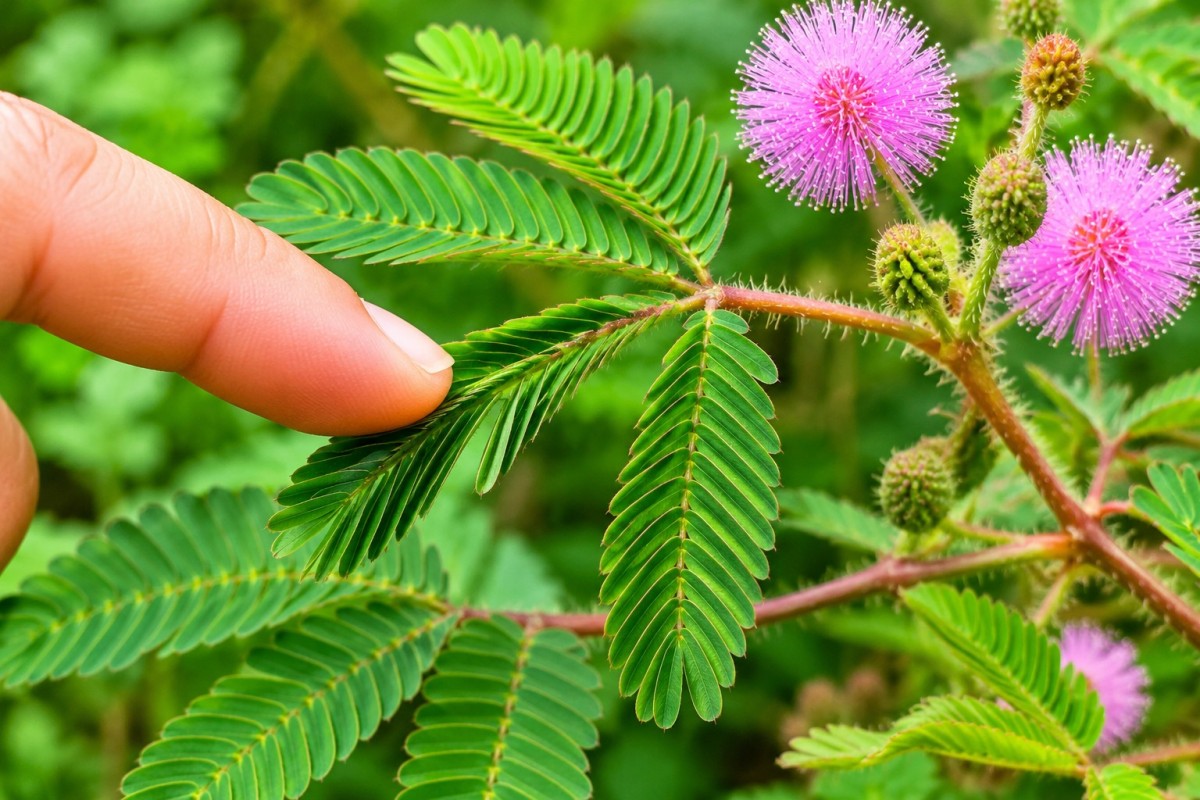
Nature never stops surprising us with its extraordinary creations. Among the most fascinating examples is the Touch-Me-Not plant, commonly known as Lajwanti or the Shy Plant in India. Unlike ordinary plants, this unique species reacts when someone touches its leaves by folding them inward and lowering its branches. This unusual behaviour makes it look as if the plant feels shy or responds to human touch.
Scientifically known as Mimosa pudica, the Touch-Me-Not plant attracts the attention of children, nature lovers and researchers because of its remarkable ability to move without muscles or a nervous system. But why does this plant fold its leaves when touched? Let’s explore the science, characteristics and interesting facts behind this fascinating plant.
Also Read: Brazilian Model Larissa Responds to Allegations of Rahul Gandhi’s Vote Chori Connection
🌿 1. What Is the Touch-Me-Not Plant?
The Touch-Me-Not plant (Mimosa pudica) is a creeping herb belonging to the legume family, Fabaceae. People commonly call it Lajwanti, Sensitive Plant, Sleeping Grass or Shy Plant.
The plant is famous for its sensitive leaves, which quickly fold when someone touches them or applies pressure. It generally grows close to the ground and produces beautiful pink or purple, round-shaped flowers.
Although people often describe it as a shy plant, its movements result from natural biological processes rather than human-like emotions.
🌱 2. Why Does the Touch-Me-Not Plant Fold Its Leaves When Touched?
One of the biggest mysteries surrounding this plant is its ability to respond immediately to physical contact.
When a person touches its leaves, the plant receives a mechanical stimulus that triggers electrical and chemical signals within its tissues. These signals cause specialised cells near the leaf joints to change their water pressure.
As water moves out of these cells, they lose pressure, causing the leaflets to fold inward and the leaf stalk to droop.
Scientists call this movement thigmonasty, which describes a plant’s non-directional movement in response to touch.
Interestingly, the plant does not need a brain, muscles or a nervous system to perform this action.
🍃 3. How Long Does the Plant Take to Open Its Leaves Again?
After the Touch-Me-Not plant folds its leaves, it gradually returns to its original position.
The recovery time depends on factors such as temperature, environmental conditions and the intensity of the stimulus. In many cases, the leaves reopen within several minutes.
However, repeated touching can temporarily reduce the plant’s response. This behaviour is one reason scientists study the plant to understand how plants respond and adapt to environmental stimuli.
🌸 4. What Makes the Touch-Me-Not Plant Different from Other Plants?
The Touch-Me-Not plant has several unusual characteristics that make it stand out in the plant kingdom.
- Sensitive leaves: Its tiny leaflets fold inward when touched.
- Night-time movement: The leaves naturally close during darkness and reopen during the day.
- Beautiful flowers: It produces small, round pink or purple flower clusters.
- Protective response: Leaf folding may discourage some herbivores by making the plant appear less attractive.
- Rapid movement: It can change the position of its leaves within seconds after receiving a stimulus.
🌍 5. Where Does the Touch-Me-Not Plant Grow?
The Touch-Me-Not plant originated in Central and South America but now grows in many tropical and subtropical regions worldwide.
In India, people commonly find it growing in:
- Gardens and open spaces
- Roadsides and grassy areas
- Agricultural fields
- Moist and sunny locations
- Forest edges and wastelands
It grows particularly well in warm climates and can spread rapidly in favourable conditions.
6. How to Grow a Touch-Me-Not Plant at Home?
People can easily grow the Touch-Me-Not plant in a garden or a small pot. It does not require complicated gardening techniques, making it an interesting plant for home gardens.
Here are some basic care tips:
Sunlight: Place the plant in a location that receives bright sunlight or partial sunlight.
Watering: Keep the soil slightly moist, but avoid excessive watering.
Soil: Use loose, well-drained soil to support healthy growth.
Temperature: The plant grows best in warm conditions.
Pruning: Trim excessive growth when necessary and control its spread.
Gardeners should remember that the plant can become invasive in some regions, so growing it in a container can help control its spread.
🔬 7. Can Plants Really Feel Human Touch?
The Touch-Me-Not plant raises an interesting scientific question: Can plants feel when humans touch them?
Plants do not experience touch in the same way humans or animals do. They do not have a brain or nervous system. However, they can detect mechanical stimuli and respond through specialised biological mechanisms.
When someone touches a Touch-Me-Not plant, it activates internal signalling processes that produce visible movement.
This demonstrates that plants can sense and respond to their surroundings in surprisingly complex ways, even without having human-like feelings or emotions.
⚠️ 8. Interesting Facts and Precautions About the Touch-Me-Not Plant
The Touch-Me-Not plant is an interesting addition to a home garden, but people should avoid disturbing it repeatedly just to watch its leaves fold.
Here are some additional facts:
- Its scientific name is Mimosa pudica.
- The word ‘pudica’ comes from Latin and refers to shyness or modesty.
- It belongs to the same botanical family as peas and beans.
- Its leaves also fold naturally during the night.
- It produces small, fluffy flowers that attract pollinators.
- Some parts of the plant have been used in traditional medicine, but many claimed health benefits lack strong clinical evidence.
People should avoid consuming the plant or using it as a home remedy without professional medical advice.
🌿 Conclusion: A Small Plant with a Remarkable Natural Ability
The Touch-Me-Not plant, or Lajwanti, proves that even ordinary-looking plants can have extraordinary abilities. Its remarkable response to human touch makes it one of nature’s most interesting examples of plant movement.
Although it may appear to behave like a shy living creature, its movements are the result of specialised biological processes. From its folding leaves to its beautiful flowers, Mimosa pudica reminds us that nature still holds countless fascinating discoveries waiting to be explored.
Also Read: Tulsi Vivah 2026: Significance, Rituals and Why This Sacred Hindu Tradition Is Celebrated