










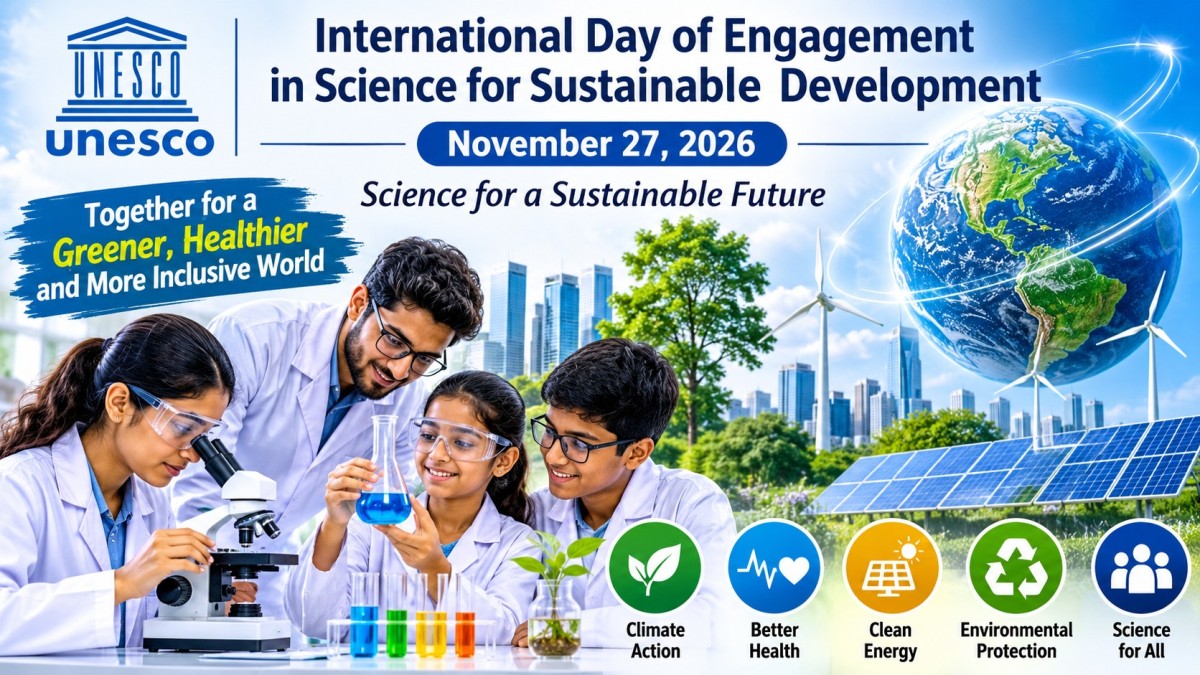
Every year on November 27, the world highlights the importance of science, innovation and public participation in building a sustainable future. The International Day of Engagement in Science for Sustainable Development encourages people, especially young generations, to explore scientific knowledge, support research and use innovation to address global challenges. In 2026, the world celebrates the first-ever observance of this international day under the leadership of UNESCO.
🌍 International Day of Engagement in Science for Sustainable Development 2026: Date and Overview
The International Day of Engagement in Science for Sustainable Development is observed annually on November 27. The day recognizes the important role that science plays in improving human lives, protecting the environment and supporting sustainable development.
UNESCO established this international observance to encourage stronger connections between science and society. It highlights that scientific progress should not remain limited to research laboratories and academic institutions. Instead, people from all backgrounds should have opportunities to understand science, participate in research and contribute to scientific discoveries.
The first celebration takes place on November 27, 2026. UNESCO is bringing together scientists, policymakers, educators, young researchers and members of civil society to promote inclusive participation in science.
Also Read: Brazilian Model Larissa Responds to Allegations of Rahul Gandhi’s Vote Chori Connection
📖 History of the International Day of Engagement in Science for Sustainable Development
The initiative to establish this international day came from Ukraine, which proposed November 27 as a date to recognize the importance of scientific engagement and sustainable development.
On April 14, 2025, the UNESCO Executive Board supported the proposal during its 221st session. Subsequently, on November 8, 2025, the UNESCO General Conference adopted the resolution proclaiming November 27 as the International Day of Engagement in Science for Sustainable Development.
The date also carries special significance for Ukraine. November 27 marks the birth anniversary of renowned Ukrainian scientist Borys Paton and the founding day of the National Academy of Sciences of Ukraine.
Following its proclamation, November 27, 2026, became the date of the first official celebration of this international observance.
🔬 Why Is Science Important for Sustainable Development?
Science plays a major role in helping societies understand challenges and develop practical solutions. From climate change and environmental protection to healthcare, agriculture and technological innovation, scientific research supports progress across almost every sector.
Scientific knowledge helps governments make informed decisions, businesses develop sustainable technologies and communities improve their quality of life.
Some major contributions of science to sustainable development include:
- Climate Action: Scientific research helps understand climate change, reduce greenhouse gas emissions and develop renewable energy solutions.
- Healthcare Innovation: Medical research supports disease prevention, improved treatments and better healthcare facilities.
- Clean Energy: Scientific advancements encourage the development of solar, wind and other renewable energy sources.
- Sustainable Agriculture: Modern agricultural technologies help farmers improve productivity while conserving natural resources.
- Environmental Protection: Research helps protect biodiversity, manage water resources and reduce pollution.
- Digital Transformation: Artificial intelligence, data science and advanced technologies create new opportunities for economic and social development.
🎯 Main Objectives of the International Day
UNESCO promotes this day with several important objectives that connect scientific knowledge with public participation.
1. Promote Science as a Common Good
The day encourages people to recognize science as an essential resource for humanity. Scientific knowledge should benefit everyone, regardless of their geographical location, economic background or educational opportunities.
2. Encourage Public Participation in Science
It promotes opportunities for ordinary citizens, students and communities to participate in scientific activities, research projects and knowledge-sharing initiatives.
3. Strengthen Science and Society Connections
The observance encourages communication between scientists, policymakers, educational institutions and the public. Stronger cooperation can help transform scientific discoveries into practical solutions.
4. Support Science Education
UNESCO highlights the importance of science education, particularly among children and young people. Better access to scientific learning can develop curiosity, creativity and problem-solving abilities.
5. Encourage International Scientific Cooperation
The day promotes collaboration between countries, research organizations and scientific communities to address challenges that affect the entire world.
🌱 Connection with the International Decade of Sciences for Sustainable Development (2024–2033)
The International Day of Engagement in Science for Sustainable Development also supports the International Decade of Sciences for Sustainable Development, which runs from 2024 to 2033.
The United Nations General Assembly proclaimed this decade on August 25, 2023, and UNESCO leads its implementation.
The initiative aims to bring together basic sciences, applied sciences, social sciences and human sciences to address global challenges.
It recognizes that sustainable development requires cooperation across different scientific disciplines. Researchers, governments, educational institutions and communities must work together to create solutions that support economic growth, social equality and environmental protection.
🇮🇳 Importance of Scientific Development in India
India has made significant progress in science, technology, space research, healthcare, agriculture and digital innovation. Scientific development continues to support the country’s economic growth and efforts to achieve sustainable development.
Organizations such as the Indian Space Research Organisation (ISRO), the Council of Scientific and Industrial Research (CSIR) and the Department of Science and Technology (DST) contribute to research, technological advancement and scientific education.
India’s achievements in space exploration, digital public infrastructure, renewable energy and pharmaceutical research demonstrate how scientific knowledge can address real-world challenges.
This international observance also provides an opportunity for Indian schools, colleges, universities and research institutions to encourage students to participate in scientific activities and innovation programmes.
👩🔬 How Can Students and Young People Participate?
Young people play an important role in shaping the future of science and technology. Their curiosity, creativity and innovative thinking can contribute to solutions for global challenges.
Students and young researchers can participate in this observance through several activities:
- Organizing science exhibitions, workshops and educational programmes.
- Participating in science fairs and innovation competitions.
- Conducting experiments and community-based research projects.
- Learning about artificial intelligence, robotics and renewable energy.
- Taking part in citizen science initiatives.
- Sharing scientific knowledge through digital platforms.
- Collaborating with educational institutions and research organizations.
These activities can help develop scientific thinking and encourage young people to become future researchers, engineers and innovators.
🌐 How Is UNESCO Celebrating the Day in 2026?
For its inaugural celebration on November 27, 2026, UNESCO is organizing a global webinar titled Science Speaks Here: Voices Marking a Sustainable Future.
The online event brings together scientists, policymakers, young researchers and representatives of civil society to discuss the importance of public engagement in science.
The programme focuses on youth participation, grassroots scientific initiatives and policies that make scientific knowledge more accessible.
UNESCO is also encouraging educational institutions, science clubs, museums, research organizations and individuals to organize local activities such as public lectures, science workshops, school experiments, science cafés and citizen science projects.
The global campaign uses the hashtag #ScienceSpeaksHere to highlight scientific engagement activities and encourage wider participation.
💡 Significance of the Day: Building a Better Future Through Science
The International Day of Engagement in Science for Sustainable Development reminds the world that scientific progress requires collective participation.
Scientific discoveries become more meaningful when people understand them and apply them to improve society. Public participation also helps researchers identify real community problems and develop solutions that address people’s needs.
As the world faces challenges such as climate change, environmental degradation, emerging diseases and technological inequalities, science can provide the knowledge and tools needed to build a better future.
The observance encourages governments, educational institutions, researchers and citizens to work together and make scientific knowledge accessible to everyone.
🌍 Conclusion
The International Day of Engagement in Science for Sustainable Development 2026 represents an important step towards making science more inclusive, accessible and connected to society. Its first celebration on November 27 highlights the importance of scientific education, research, innovation and public participation.
Through this initiative, UNESCO encourages individuals and communities to become active participants in scientific progress. Building a sustainable future is a shared responsibility, and science can play a powerful role in creating a healthier, more innovative and environmentally responsible world.
The message of the day is clear: Science is not just for scientists; it is for everyone, and everyone has a role to play in shaping a sustainable future.