







India observes Lal Bahadur Shastri Jayanti on October 2 every year to mark the birth anniversary of the country’s second Prime Minister. Born on October 2, 1904, in Mughalsarai, Uttar Pradesh, Shastri grew up in modest circumstances and went on to become one of the important leaders of independent India. He served as Prime Minister from June 9, 1964, until January 11, 1966.
His life reflected simplicity, discipline, courage and dedication to public service. He joined India’s freedom struggle at a young age, faced imprisonment under British rule and later took responsibility for several important positions in the government. His journey from a small railway town to the highest elected office in the country remains an important chapter in India’s political history.
Also Read: Brazilian Model Larissa Responds to Allegations of Rahul Gandhi’s Vote Chori Connection
🌱 From a Modest Childhood to the Freedom Movement
Lal Bahadur Shastri was born into a family with limited financial resources. His father worked as a school teacher and died when Shastri was only about one and a half years old. His mother raised her three children at her parental home.
As a student, Shastri developed an interest in India’s freedom movement. At the age of 16, he responded to Mahatma Gandhi’s call to join the Non-Cooperation Movement and left his formal studies. He later joined Kashi Vidya Peeth in Varanasi, where he studied at a national educational institution established during the freedom struggle. He received the title “Shastri” after completing his studies there, and the title later became part of his name.
Shastri actively participated in the independence movement and spent several years in British prisons. The freedom struggle strengthened his commitment to public service and prepared him for a long political career.
🇮🇳 Building a Political Career After Independence
After India gained independence in 1947, Shastri took on several responsibilities in government. He initially served in Uttar Pradesh and later moved to the national political scene.
He held several Union Cabinet portfolios, including Railways, Transport and Communications, Commerce and Industry, and Home Affairs. His approach to public responsibility became particularly visible when he resigned as Railway Minister following a major railway accident. He accepted political responsibility even though Prime Minister Jawaharlal Nehru publicly stated that Shastri was not personally responsible for the accident.
This episode became an important part of Shastri’s public record and reflected the principle of accepting responsibility while holding public office.
🏛️ Becoming India’s Second Prime Minister
Jawaharlal Nehru died in May 1964, creating a major transition in India’s leadership. After a brief interim period under Gulzari Lal Nanda, Lal Bahadur Shastri became Prime Minister on June 9, 1964. He led the country during a period that brought serious economic, agricultural and security challenges.
Shastri faced the responsibility of strengthening the country while dealing with food shortages and other economic pressures. His government placed considerable attention on agriculture and food production while also addressing national security concerns.
🌾 “Jai Jawan, Jai Kisan” Connects Soldiers and Farmers
During the 1965 India-Pakistan war, Shastri provided political leadership while the armed forces faced the military challenge. At the same time, India needed to strengthen domestic food production.
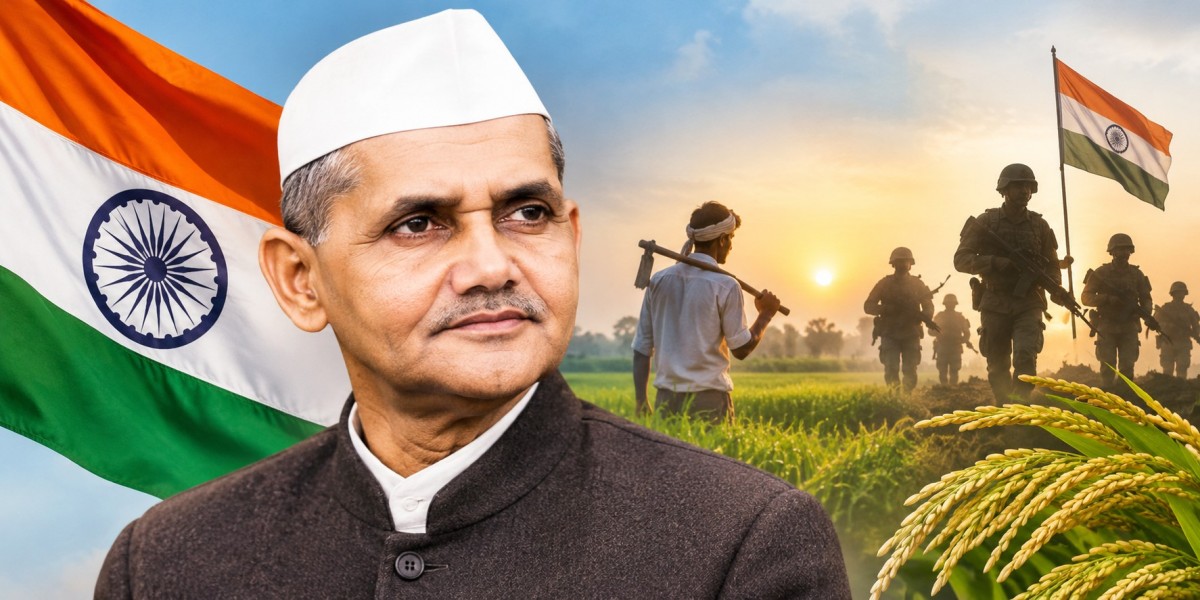
Shastri gave the country the famous slogan “Jai Jawan, Jai Kisan”, highlighting the contribution of soldiers and farmers. The phrase connected national security with food security and became one of the most recognised expressions associated with his leadership. The Prime Minister’s Office continues to cite the slogan in discussions about Shastri’s legacy.
His message recognised two groups that played crucial roles during a difficult period: soldiers defending the country and farmers supporting its food needs.
🪖 Leadership During the 1965 War
The 1965 India-Pakistan war became one of the defining events of Shastri’s tenure. His government supported the Indian armed forces during the conflict and maintained its focus on national security.
The war ended with diplomatic negotiations. Shastri travelled to Tashkent in January 1966 for talks with Pakistan’s President Ayub Khan. The discussions resulted in the Tashkent Declaration, which the two sides signed on January 10, 1966.
Shastri died in Tashkent on January 11, 1966, shortly after signing the declaration. His sudden death ended a relatively short but significant period as Prime Minister.
🕊️ A Legacy of Simplicity and Responsibility
Shastri’s public image rested strongly on his simple lifestyle and personal conduct. The official Prime Minister’s biography describes him as humble and tolerant while also highlighting his inner strength and determination.
His political career also demonstrated the importance he placed on responsibility. From participating in the freedom movement to handling major national challenges as Prime Minister, he maintained a strong connection with the idea of public service.
His influence did not come only from the length of his time in office. Instead, important moments from his career—including his resignation as Railway Minister, leadership during the 1965 war and emphasis on farmers and soldiers—continue to shape how people remember him.
📜 Why Lal Bahadur Shastri Jayanti Remains Important
October 2 carries a special place in India’s calendar because the country remembers both Lal Bahadur Shastri and Mahatma Gandhi on their birth anniversaries. The Ministry of Culture has also recorded the national commemoration of Shastri’s birth centenary from October 2, 2003, to October 2, 2004.
Lal Bahadur Shastri Jayanti provides an opportunity to look at the values associated with his public life. His story highlights how an individual from a modest background entered the freedom movement, accepted responsibilities in government and eventually led India during a challenging period.
🌼 Conclusion
Lal Bahadur Shastri’s life remains closely connected with simplicity, service, responsibility and national duty. His tenure as Prime Minister lasted less than two years, but major events during that period left a lasting place in India’s history.
On Lal Bahadur Shastri Jayanti 2026, remembering his life means looking beyond political office and focusing on the principles he brought to public service. His words “Jai Jawan, Jai Kisan” continue to recall the contribution of India’s soldiers and farmers, while his journey remains a significant part of the nation’s history.
Also Read: International Coffee Day 2026: Celebrating the World’s Favourite Brew