







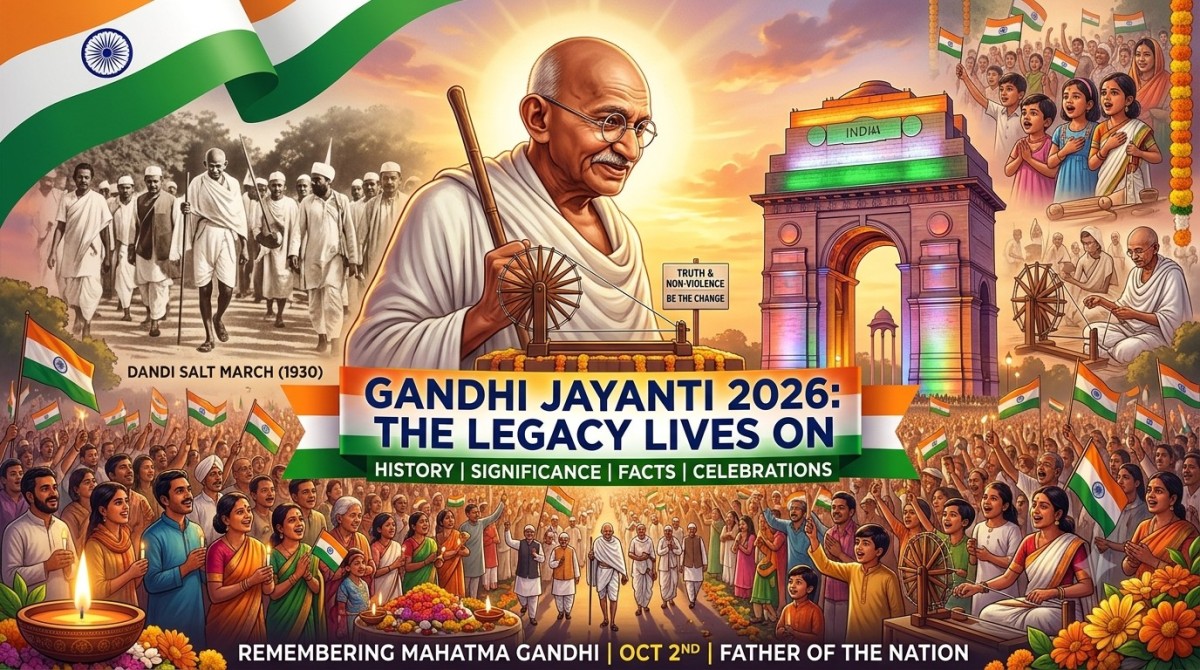
Gandhi Jayanti is celebrated every year on 2 October to mark the birth anniversary of Mahatma Gandhi, one of the most important leaders of India’s freedom movement. In 2026, Gandhi Jayanti will fall on Friday, 2 October, marking Gandhi’s 157th birth anniversary.
The day reminds people of Gandhi’s principles of truth, non-violence, simplicity and peaceful resistance. Moreover, the United Nations observes 2 October as the International Day of Non-Violence, giving the date global significance.
📜 Gandhi Jayanti 2026: History

Mahatma Gandhi, whose full name was Mohandas Karamchand Gandhi, was born on 2 October 1869 in Porbandar, Gujarat. He studied law in London and later travelled to South Africa. During his years in South Africa, he experienced racial discrimination and developed many of the ideas that later shaped his approach to social and political activism.
After returning to India, Gandhi gradually became a major leader of the freedom movement. He encouraged Indians to challenge British rule through peaceful protests, civil disobedience and non-cooperation.
For example, Gandhi led the famous Salt March in 1930 to challenge the British salt laws. Consequently, the movement attracted widespread public participation and became an important event in India’s struggle for independence.
🕊️ Why Is Gandhi Jayanti Celebrated?
India celebrates Gandhi Jayanti to remember Mahatma Gandhi’s life, ideas and contribution to the freedom movement. At the same time, the day encourages people to reflect on values such as truth, peace and non-violence.
Gandhi believed that people could challenge injustice without using physical violence. Therefore, he promoted peaceful resistance and civil disobedience as ways to bring social and political change.
His philosophy later influenced several movements around the world. As a result, people in many countries continue to study his approach to peaceful resistance.
🇮🇳 Gandhi Jayanti 2026 Date and Day
- Date: 2 October 2026
- Day: Friday
- Occasion: Gandhi Jayanti
- Birth Anniversary: 157th birth anniversary of Mahatma Gandhi
- International Observance: International Day of Non-Violence
Thus, 2 October holds both national and international importance. While India remembers Gandhi on his birth anniversary, the United Nations uses the date to promote the message of non-violence around the world.
🌍 International Day of Non-Violence
The United Nations established the International Day of Non-Violence in 2007. The organisation chose 2 October because the date marks Mahatma Gandhi’s birth anniversary.
The day promotes awareness about peaceful methods of resolving conflicts. Furthermore, it encourages education and public discussion about non-violence, peace and understanding.
Gandhi’s philosophy has influenced people and movements far beyond India. Therefore, his birth anniversary has become an occasion for discussing non-violent approaches to social change on an international level.
🧘 Importance of Truth and Non-Violence
Truth and non-violence formed important parts of Gandhi’s philosophy. He believed that people should follow truth not only in public life but also in their personal actions.
Similarly, Gandhi viewed non-violence as more than simply avoiding physical conflict. He connected it with peaceful resistance, self-discipline and respect for others.
His approach encouraged people to oppose injustice without responding with violence. As a result, non-violent protest became an important feature of several campaigns associated with India’s freedom movement.
🧹 How Is Gandhi Jayanti Celebrated in India?
People across India observe Gandhi Jayanti through educational, cultural and community activities. Schools and colleges often organise essay competitions, speeches, quizzes, drawing competitions and debates about Gandhi and the freedom movement.
In addition, many organisations conduct cleanliness drives and community programmes. These activities reflect Gandhi’s emphasis on cleanliness, discipline and social responsibility.
Prayer meetings also form an important part of Gandhi Jayanti commemorations. Meanwhile, government institutions and Gandhi memorials organise programmes to remember his life and contribution.
🏛️ Gandhi Jayanti at Raj Ghat
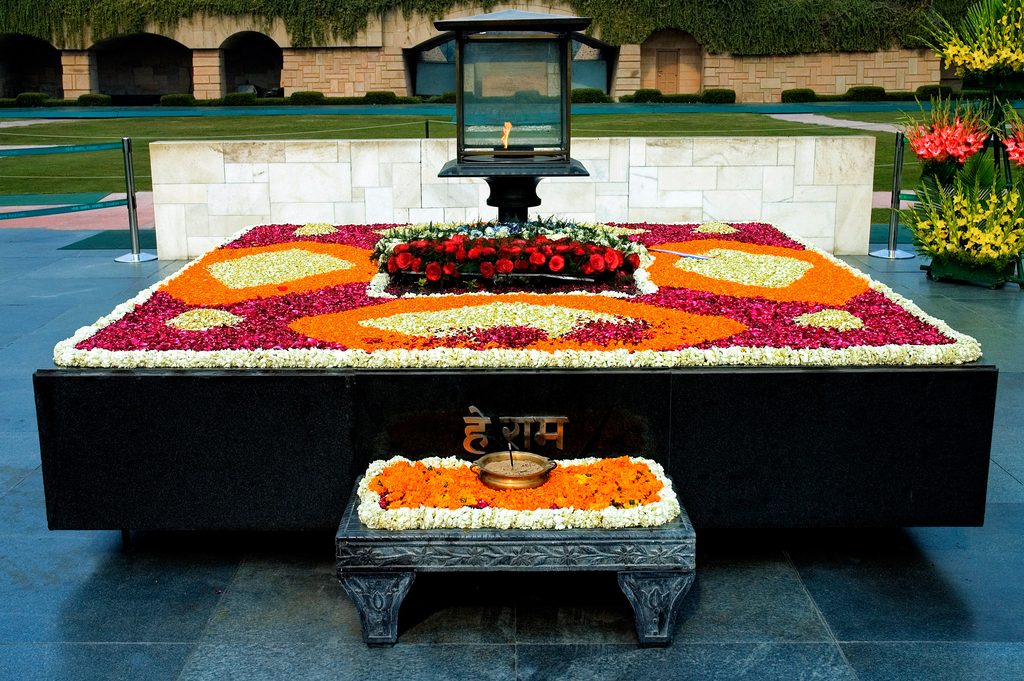
Raj Ghat in New Delhi serves as the memorial site dedicated to Mahatma Gandhi. On Gandhi Jayanti, national leaders and other dignitaries traditionally visit Raj Ghat to pay their respects.
The ceremony provides an important moment of remembrance. In addition, it forms part of the larger national observance held across India on 2 October.
📚 Mahatma Gandhi’s Role in India’s Freedom Movement
Gandhi played a major role in mobilising people during India’s freedom struggle. He encouraged citizens from different sections of society to participate in peaceful movements against British rule.
Several major movements became associated with his leadership, including the Non-Cooperation Movement, Civil Disobedience Movement and Quit India Movement.
The Salt March of 1930 remains one of the most recognised examples of Gandhi’s method of civil disobedience. He and his followers marched to Dandi to challenge the British monopoly over salt production.
Similarly, the Quit India Movement of 1942 became a major mass movement demanding an end to British rule in India. Gandhi’s call for peaceful resistance made him one of the central figures of the independence movement.
💡 Interesting Facts About Mahatma Gandhi
- Mahatma Gandhi was born on 2 October 1869 in Porbandar, Gujarat.
- His full name was Mohandas Karamchand Gandhi.
- Gandhi studied law in London and trained as a barrister.
- He spent several years in South Africa, where he developed important ideas about civil rights and peaceful resistance.
- Gandhi became one of the leading figures of India’s freedom movement.
- Truth and non-violence remained central themes throughout his public life.
- Gandhi led the famous Salt March in 1930.
- He played a major role in several important movements against British colonial rule.
- The United Nations established 2 October as the International Day of Non-Violence in 2007.
- Gandhi’s ideas about peaceful resistance have influenced social and civil rights movements around the world.
🌱 Gandhi’s Message for the Present Generation
Gandhi Jayanti also gives young people an opportunity to learn from history. His ideas about peaceful communication, personal responsibility and social awareness remain topics of discussion in schools and educational institutions.
For instance, students can study Gandhi’s role in the freedom movement and understand how peaceful protest became an important method of challenging injustice. At the same time, they can explore how his ideas influenced movements outside India.
Therefore, Gandhi Jayanti can serve as more than a historical commemoration. It can also encourage discussions about peace, responsibility, cooperation and respect for others.
🎓 Gandhi Jayanti Activities for Students
Schools can organise several activities to make Gandhi Jayanti educational and engaging. For example, students can participate in essay writing, quizzes, debates, poster-making competitions and speech competitions.
Teachers can also introduce students to important events from Gandhi’s life. In addition, classroom discussions can focus on concepts such as truth, non-violence, civil disobedience and India’s independence movement.
Cleanliness activities can also form part of school celebrations. Such programmes encourage students to think about their responsibility towards their surroundings and community.
🌏 Gandhi’s Global Legacy
Gandhi’s influence extends beyond India. His ideas about non-violent resistance have attracted attention from scholars, activists and leaders around the world.
Moreover, the United Nations’ decision to observe 2 October as the International Day of Non-Violence highlights the international importance associated with Gandhi’s philosophy.
Today, Gandhi remains an important historical figure whose life and ideas continue to receive attention in discussions about peace, non-violence and social change.
✨ Conclusion
Gandhi Jayanti 2026 will take place on Friday, 2 October, marking the 157th birth anniversary of Mahatma Gandhi. The occasion allows people to remember his contribution to India’s freedom movement and learn about his emphasis on truth and non-violence.
Furthermore, the international observance of 2 October as the International Day of Non-Violence gives the occasion a global dimension. Ultimately, Gandhi Jayanti remains an important day for learning about Indian history and reflecting on the values of peace, responsibility and non-violent action.