










Laws are created to maintain order, protect people, and regulate everyday life. But around the world, some laws and regulations can seem surprisingly unusual when viewed from another culture or era.
From restrictions on chewing gum to rules about naming children, these laws have attracted attention for being particularly strange or unexpected. However, it is worth remembering that some popular “weird law” stories are myths, outdated rules, or laws that apply only in very specific circumstances.
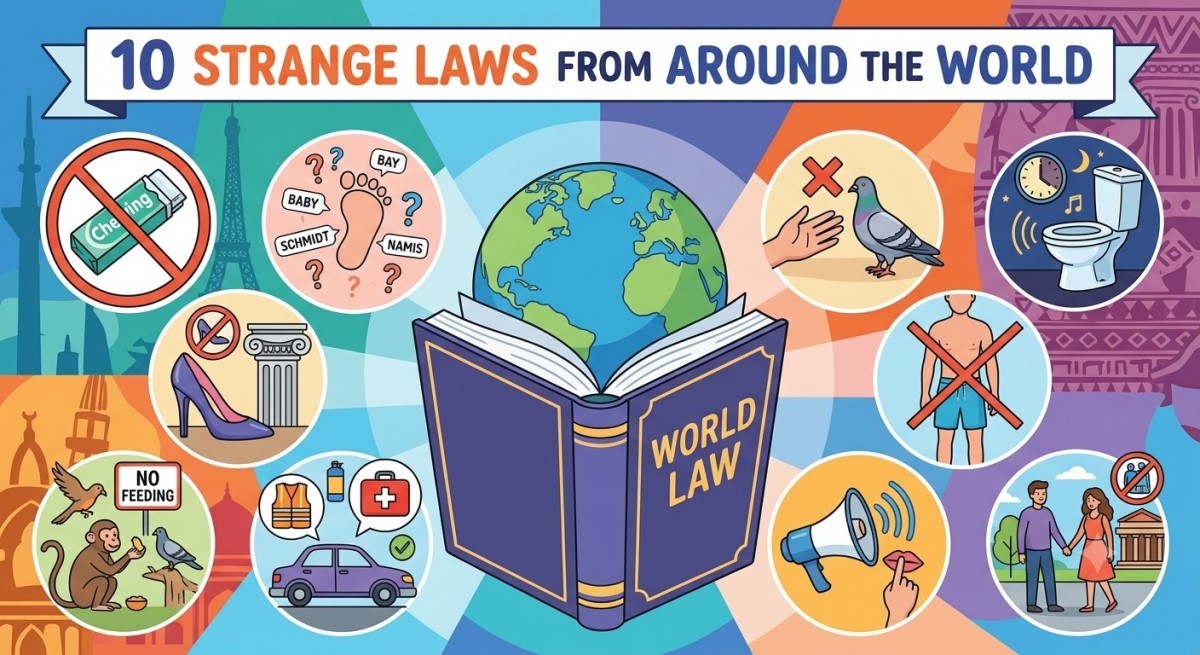
Here are 10 unusual laws and regulations from different parts of the world that have sparked curiosity.
🍬 1. Chewing Gum Restrictions in Singapore
Singapore is well known for its clean streets and strict public regulations. One of the most famous examples is its restriction on chewing gum.
Singapore does not generally ban people from simply chewing gum, but the import and sale of ordinary chewing gum are heavily restricted. Certain therapeutic and dental gums can be obtained under specific conditions.
The rules were introduced partly because discarded chewing gum had become a nuisance, including problems involving public transportation and public facilities.
Why it seems strange: In many countries, buying a packet of chewing gum is completely ordinary. In Singapore, however, the rules surrounding it are considerably stricter.
👶 2. Naming Rules for Children in Germany
Germany has regulations concerning children’s names. Parents cannot freely choose just any name if it could harm the child’s interests or create serious problems for them.
Civil registry offices can reject names considered inappropriate, offensive, or clearly unsuitable. In some cases, parents may be asked to provide evidence that an unusual name is an established given name.
Why it seems strange: Naming a baby is usually viewed as a deeply personal decision. German authorities can have a role in preventing names that could potentially disadvantage a child.
🐦 3. Don’t Feed Pigeons in Venice
Venice, Italy, has long struggled with the effects of large numbers of pigeons in its historic center. As a result, authorities introduced restrictions against feeding pigeons in public places.
The rule is intended to protect historic buildings, monuments, and public spaces from damage and excessive bird populations.
Why it seems strange: Feeding birds can seem like a harmless tourist activity. In Venice, however, that seemingly innocent habit can result in a fine.
👠 4. High-Heel Restrictions at Some Greek Archaeological Sites
Visitors to certain ancient archaeological sites in Greece are prohibited from wearing high-heeled shoes.
The purpose is not fashion control. High heels can potentially damage fragile ancient surfaces, particularly at historically significant monuments and archaeological locations.
Why it seems strange: Clothing choices are rarely associated with archaeological preservation. In Greece, however, footwear can become part of the effort to protect ancient heritage.
🚽 5. The Myth About Flushing Toilets at Night in Switzerland
One popular claim says that flushing a toilet after a particular hour is illegal in Switzerland. This story has circulated widely online, but it is generally misleading.
There is no nationwide Swiss law that simply makes nighttime toilet flushing illegal. However, apartment buildings can have house rules or noise-related expectations, particularly in buildings where residents are expected to avoid unnecessary disturbance.
Why it seems strange: A normal household activity can sound bizarre when presented as a criminal law. In reality, this is a good example of how internet “weird law” lists can turn a building rule or social expectation into an exaggerated legal claim.
👕 6. Restrictions on Going Shirtless in Public
In several cities and tourist destinations around the world, local regulations can prohibit going shirtless in certain public areas.
These rules are often associated with town centers, restaurants, shopping districts, religious sites, or other locations where authorities expect a particular standard of dress.
Why it seems strange: Going shirtless may be completely normal at a beach but considered inappropriate—or even subject to a local fine—just a short distance away.
🐒 7. Restrictions on Feeding Wild Animals
Various cities around the world have introduced laws or local regulations restricting the feeding of wild animals, including pigeons, monkeys, and other urban wildlife.
These rules can be designed to prevent aggressive animal behavior, disease, litter, property damage, and population growth.
Why it seems strange: People often feed animals because they want to help them. Authorities may see the same behavior as contributing to a larger public-health or environmental problem.
🚗 8. Surprisingly Specific Driving Rules
Some countries have unusually detailed traffic regulations. These can cover everything from where vehicles may stop to what equipment must be carried in a car.
For example, several European countries require drivers to carry specific safety equipment, while other jurisdictions have rules concerning winter tires, warning triangles, reflective vests, or emergency supplies.
Why it seems strange: Drivers often think of traffic laws as being limited to speed limits and road signs. In reality, some countries regulate the contents and equipment of vehicles in considerable detail.
🔊 9. Unusual Rules About Public Behavior
Cities sometimes create local rules covering behavior that might seem too minor to deserve legislation.
Examples around the world have included restrictions on activities such as excessive public noise, certain types of street performances, feeding wildlife, littering, or using public spaces in particular ways.
These rules are usually connected to practical concerns such as public safety, cleanliness, tourism, or protecting residents’ quality of life.
Why it seems strange: What is considered normal public behavior can vary dramatically from one city or culture to another.
❤️ 10. Strict Rules About Public Displays
Certain countries and cities regulate public displays of affection, clothing, photography, or behavior around religious and cultural sites.
The rules can be particularly strict around temples, churches, mosques, government buildings, and historic monuments.
Why it seems strange: Tourists may assume that ordinary behavior is acceptable everywhere. Local laws and cultural expectations can be very different, however, and ignorance of those rules does not necessarily exempt visitors from penalties.
🤔 Why Do These Strange Laws Exist?
Many unusual laws make more sense when we look at the problem they were designed to address.
A ban on feeding pigeons may help protect historic buildings. Restrictions on footwear can protect ancient monuments. Rules about children’s names can focus on a child’s welfare. Regulations on chewing gum may be connected to public cleanliness.
In other cases, however, an alleged “strange law” may simply be an outdated rule, a local regulation, a building policy, or an internet myth that has been repeated so many times that it sounds factual.
🌎 The Lesson Behind Strange Laws
The world’s legal systems reflect the history, culture, environment, and practical problems of the places where they operate. A rule that seems completely unnecessary in one country may have a logical explanation in another.
So the next time you hear that something bizarre is “illegal” somewhere, it is worth checking the original law before believing the headline.
After all, the truth behind strange laws is often more interesting than the myth itself.