










Space is one of the most mysterious places in existence. The environment beyond Earth is so different that many things happening there can sound completely impossible to us.
From floating water droplets and silent spacewalks to strange sunsets and changing human bodies, astronauts and scientists have witnessed phenomena that challenge our everyday understanding of the world. Here are 10 fascinating things that really happen in space.
🌌 1. Astronauts Can Become Taller in Space
When astronauts leave Earth, their bodies are no longer affected by gravity in the same way. Without Earth’s constant gravitational pull compressing the spine, the spaces between the vertebrae can expand slightly.
As a result, astronauts can temporarily become a few centimetres taller while living in space. However, they usually return to their normal height after coming back to Earth.
💧 2. Water Can Float Like a Giant Bubble
On Earth, gravity causes water to fall downward and spread across surfaces. In microgravity, water behaves very differently.
Water droplets can float freely inside a spacecraft and often form almost perfect spheres because surface tension pulls the water molecules together. Astronauts can even push these floating droplets around with their hands.

🔇 3. Space Is Completely Silent
Movies often show loud explosions in space, but real space is much quieter. Sound needs a medium such as air, water, or solid material to travel.
Because most of outer space is an extremely thin vacuum, sound waves cannot travel normally through it. An astronaut outside a spacecraft would not hear someone shouting nearby unless there were communication equipment connecting them.
🌅 4. Astronauts Can See Many Sunrises in One Day
The International Space Station travels around Earth at an incredible speed. It completes an orbit roughly every 90 minutes.
Because of this rapid orbit, astronauts aboard the station can experience approximately 16 sunrises and 16 sunsets every 24 hours. Instead of waiting an entire day for another sunrise, they can see one roughly every 45 minutes.
🛰️ 5. Astronauts Are Constantly Falling Around Earth

Astronauts inside the International Space Station appear to float because they are experiencing microgravity. They are not beyond Earth’s gravity; Earth’s gravity is still pulling on them.
The station and everything inside it are continuously falling toward Earth while moving forward at tremendous speed. Because of this combination of motion and gravity, they keep missing Earth and remain in orbit.
👨🚀 6. The Human Body Changes in Space
The human body evolved to live under Earth’s gravity, so space can have a noticeable effect on it. In microgravity, muscles do not have to work as hard to support the body.
Over time, astronauts can experience muscle loss and reduced bone density. Their body fluids also shift toward the upper body and head, which can make their faces appear slightly puffier.
That is why astronauts follow carefully designed exercise routines while living in space.
🔥 7. Fire Behaves Completely Differently
A normal flame on Earth usually has a familiar teardrop shape because hot gases rise while cooler air moves downward. This process is driven largely by gravity.
In microgravity, there is no normal upward movement of hot gases. As a result, flames can become rounder and behave differently, and they may burn at lower temperatures.
Scientists study these unusual flames because they can teach us more about combustion and potentially help improve fire safety in spacecraft.
🧊 8. Space Can Be Extremely Cold and Extremely Hot
It might seem that everything in space must simply be freezing cold, but the reality is more complicated. An object directly exposed to sunlight can become extremely hot, while another object in shadow can become very cold.
This happens because there is almost no atmosphere in space to distribute heat in the way Earth’s atmosphere does. Spacecraft therefore require carefully designed systems to control their temperature.
🔴 9. Sunsets on Mars Can Look Blue
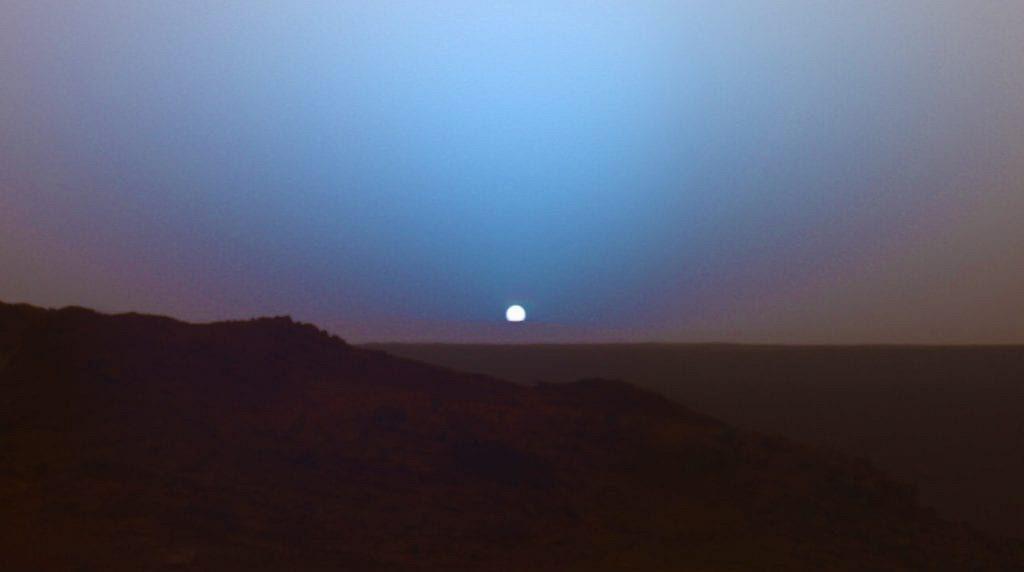
Earth is famous for its colourful sunsets, but Mars has its own unusual version. Dust in the Martian atmosphere affects the way sunlight is scattered.
Near sunset, the sky around the Sun can take on a bluish appearance, while the surrounding sky may show reddish and yellowish colours. It is almost the opposite of the typical reddish sunsets we see on Earth.
🪐 10. A Planet Can Have a Day Longer Than Its Year
Venus has one of the strangest rotations in the Solar System. It takes approximately 243 Earth days to rotate once on its axis.
However, Venus completes one orbit around the Sun in about 225 Earth days. So, measured by its rotation, a Venusian day is actually longer than its year.
🌠 Bonus: Space Has No Clear “Up” or “Down”
On Earth, we naturally think of up and down because gravity gives us a clear sense of direction. In space, astronauts can turn themselves around and look at the ceiling, floor, or walls from almost any orientation.
Inside a spacecraft, astronauts often use straps, handrails, and specially designed sleeping bags to keep themselves in place. In microgravity, direction becomes more a matter of perspective than a fixed rule.
✨ Why Space Is So Fascinating
These examples show how different the universe can be from our everyday experience on Earth. Gravity, atmosphere, temperature, and even the behaviour of fire and water can change dramatically once we leave our planet.
Space exploration continues to reveal new discoveries, and there is still an enormous amount we don’t understand about the universe. What seems impossible today may simply be another fascinating scientific fact waiting to be discovered. 🚀🌌