










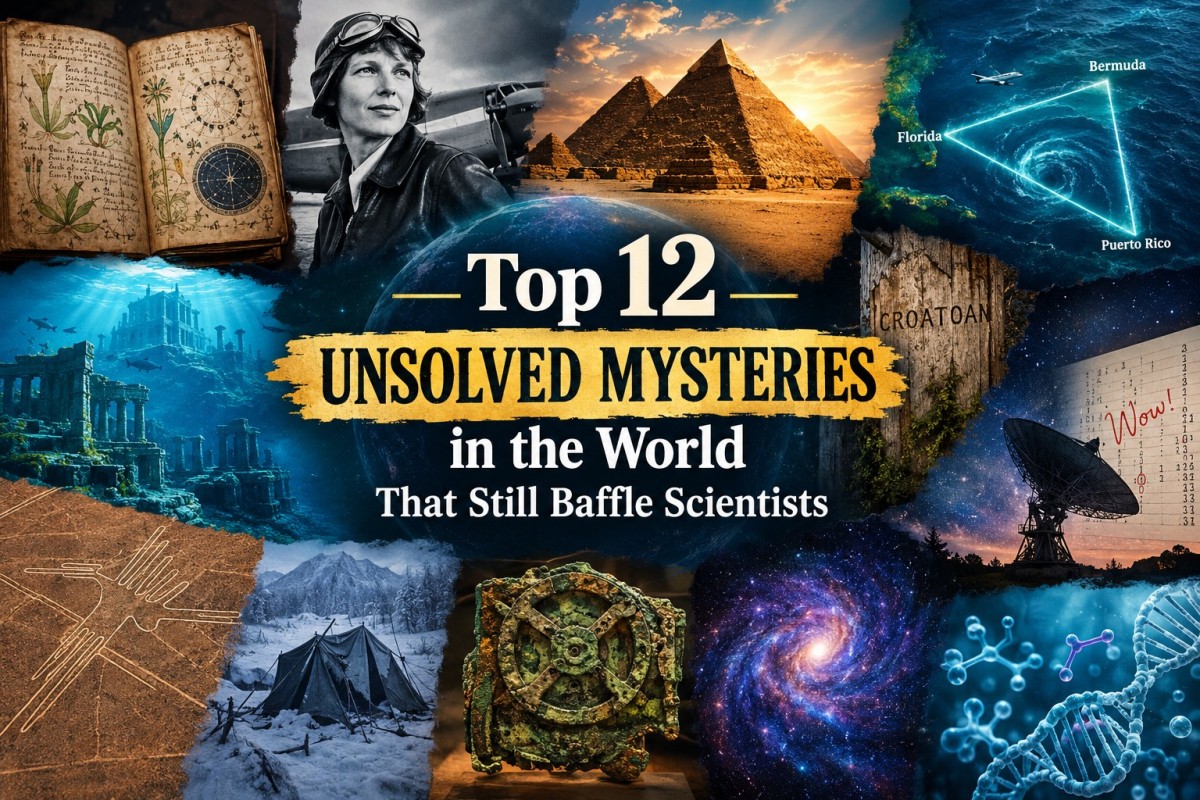
The world holds countless secrets that continue to puzzle scientists, historians, and researchers. From mysterious ancient manuscripts to strange signals from space, some questions still have no clear answers. Despite advances in science and technology, researchers continue to investigate these fascinating puzzles.
In this article, we explore 12 unsolved mysteries in the world, examine the leading theories, and discover why these questions continue to capture our imagination.
Also Read : Bihar MLC Election 2026: Neeraj Singh Leads in Patna, BJP Ahead in Tirhut
🗿 1. The Mystery of the Voynich Manuscript
The Voynich Manuscript remains one of the world’s most puzzling books. Experts believe someone created this illustrated manuscript during the early 15th century. However, nobody has reliably deciphered its unusual writing.
The pages contain strange symbols, unfamiliar plants, astronomical diagrams, and unusual human illustrations. Because of these features, researchers have proposed several theories. Some believe the text uses an unknown language, while others suspect it contains an elaborate code.
Nevertheless, no theory has gained widespread acceptance. The biggest mystery remains the meaning of the text and the purpose of the manuscript.
✈️ 2. The Disappearance of Amelia Earhart
Amelia Earhart made history as a pioneering aviator. However, her final flight became one of aviation’s greatest mysteries.
In July 1937, Earhart and her navigator, Fred Noonan, attempted to fly around the world. During their journey, they disappeared over the Pacific Ocean while travelling toward Howland Island.
Search teams explored the surrounding ocean, but they found no conclusive evidence of the aircraft or its occupants. Some researchers believe the plane crashed into the sea after running out of fuel. Others suggest that Earhart and Noonan may have landed on a remote island.
Although investigators have examined numerous clues, the exact location and circumstances of their disappearance remain unknown.
🔺 3. How Were the Egyptian Pyramids Built?
The Great Pyramid of Giza continues to amaze historians and engineers. Built over 4,500 years ago, it showcases the ancient Egyptians’ remarkable planning and engineering skills.
Archaeologists have found tools, quarries, and evidence of stone transportation. However, researchers still debate the exact methods used to lift and position the massive blocks. Theories include ramps, levers, and organized labor.
Despite popular myths, evidence points to ancient Egyptian builders. The mystery lies in exactly how they constructed this incredible monument.

🌊 4. The Mystery of the Bermuda Triangle
The Bermuda Triangle occupies a region of the western North Atlantic Ocean, roughly between Florida, Bermuda, and Puerto Rico. Over the years, stories about missing ships and aircraft have made this area famous.
Some theories blame unusual magnetic forces or mysterious phenomena. However, investigators have linked many reported incidents to more familiar causes, such as severe weather, mechanical problems, and navigation errors.
Moreover, researchers have not established that the region experiences an unusually high disappearance rate compared with other busy ocean areas.
Therefore, the Bermuda Triangle’s reputation may owe more to popular storytelling than to evidence of a mysterious force. Some individual incidents still raise questions, but no single explanation accounts for every case.
🏝️ 5. What Happened to the Roanoke Colony?
In the late 16th century, English settlers established a colony on Roanoke Island in present-day North Carolina. However, when an expedition returned in 1590, the settlement stood abandoned.
The returning explorers reportedly found the word “CROATOAN” carved into a post. This clue sparked many theories about the colonists’ fate.
Some historians believe the settlers moved to nearby Indigenous communities. Others suggest that food shortages, disease, conflict, or harsh living conditions forced them to leave.
Archaeologists continue to investigate the region for clues. Yet researchers still lack enough evidence to establish exactly what happened to every colonist.
👽 6. The Wow! Signal: A Mysterious Signal from Space
In August 1977, astronomer Jerry Ehman noticed an unusual radio signal recorded by Ohio State University’s Big Ear radio telescope. The signal lasted about 72 seconds and attracted attention because of its distinctive characteristics.
Ehman wrote “Wow!” beside the data, giving the signal its famous name. Since the signal appeared near a frequency of interest to researchers searching for extraterrestrial intelligence, scientists began examining its possible origin.
However, later observations did not reproduce the original signal conclusively. Researchers have considered natural and human-related explanations, but none has definitively solved the mystery.
Importantly, scientists have found no confirmed evidence that aliens sent the signal. Its precise origin remains unknown.
🏺 7. The Lost City of Atlantis

Atlantis has fascinated people for centuries. Around 360 BCE, the Greek philosopher Plato described a powerful island civilization that disappeared beneath the sea after a catastrophe.
Researchers have suggested several possible locations for Atlantis. One theory links the legend to the volcanic eruption of Thera, now Santorini, which devastated parts of the ancient Aegean world.
However, no widely accepted archaeological evidence confirms Atlantis existed as Plato described it. Many scholars believe it was a philosophical story rather than a real civilization. The mystery remains whether real events inspired Plato’s tale or he invented it to share his ideas.
🛸 8. The Nazca Lines: Giant Drawings in the Desert
The Nazca Lines are enormous designs etched into the desert of southern Peru. These ancient geoglyphs depict animals, plants, geometric shapes, and long straight lines.
Ancient communities created the designs by removing dark surface stones and exposing the lighter ground beneath. As a result, many patterns remain visible across the desert landscape.
Researchers have suggested several possible purposes. Some designs may have served ceremonial or religious functions, while others may have related to water, landscapes, or astronomical observations.
However, scientists have not established one explanation for every design. Although some popular theories connect the lines to aliens, no credible evidence supports that claim.
Researchers continue to study the geoglyphs to understand their full cultural meaning.
🧊 9. The Dyatlov Pass Incident
In February 1959, nine hikers died during an expedition in the northern Ural Mountains. Investigators later found their tent damaged, while the hikers’ bodies lay in the surrounding area.
The unusual circumstances encouraged theories involving secret military experiments and other extraordinary events. However, researchers have also examined natural explanations.
For instance, a scientific study published in 2021 explored how a delayed snow-slab avalanche might have contributed to the tragedy. Severe weather and the hikers’ response to danger may also have played important roles.
Although these explanations offer plausible scenarios, researchers cannot reconstruct every moment with certainty. The exact sequence of events and the reasons each hiker died remain subjects of investigation.
⚙️ 10. The Antikythera Mechanism: An Ancient Technological Wonder
Divers discovered the Antikythera Mechanism in a shipwreck near the Greek island of Antikythera in 1901. Researchers later identified it as an intricate mechanical device that could model astronomical cycles.
The mechanism contains complex bronze gears, demonstrating the impressive technical knowledge of ancient Greek craftsmen. Studies suggest that it helped users track celestial movements and predict events such as eclipses.
Modern imaging techniques have revealed more about its internal structure. Nevertheless, many fragments remain damaged or missing, limiting our understanding of the original device.
Researchers continue to examine its inscriptions and mechanical design. Although scientists understand much of its function, important questions remain about its complete structure, maker, and place in ancient technology.
🌌 11. What Is Dark Matter?
Dark matter ranks among the biggest unanswered questions in modern physics. Scientists infer its existence from gravitational effects that visible matter alone cannot adequately explain.
For example, observations of galaxies and galaxy clusters suggest that unseen matter influences how these structures move. Dark matter also plays an important role in scientific models of the universe’s large-scale structure.
Researchers have proposed several possible candidates, including hypothetical particles that interact only weakly with ordinary matter. Meanwhile, experiments around the world continue to search for direct evidence of these particles.
So far, scientists have not confirmed the identity of dark matter. It is also important to distinguish dark matter from dark energy, which researchers associate with the accelerating expansion of the universe.
The central mystery is what dark matter consists of and how it produces the gravitational effects scientists observe.
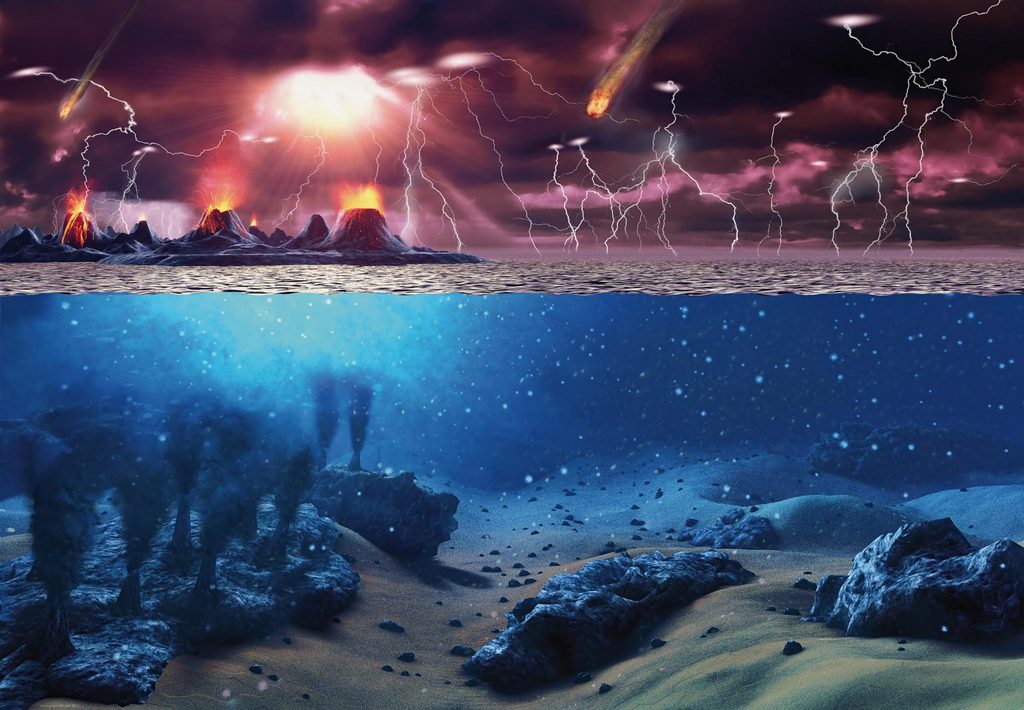
🧬 12. How Did Life First Begin on Earth?
Scientists understand much about evolution, but the origin of the first living systems remains a mystery.
Researchers study this process, known as abiogenesis, to understand how simple molecules formed complex compounds and early life. Experiments show that some building blocks of life can form under conditions similar to those on early Earth.
However, scientists have not yet established exactly how non-living chemistry developed into the first living organisms.
The biggest question is how these chemical processes combined to create the earliest life.
🔍 Conclusion: Will Scientists Ever Solve These Mysteries?
These 12 unsolved mysteries show how much we still have to learn about our planet, our history, and the universe.
Some mysteries may eventually yield to new discoveries. For example, improved imaging technology may reveal archaeological clues, while future experiments may help scientists identify dark matter. Similarly, researchers may uncover new evidence about historical disappearances.
However, other mysteries may remain partly unresolved because time has destroyed important evidence or records.
Ultimately, these questions remind us that scientific knowledge continues to grow. Every new discovery can challenge an old theory, inspire fresh research, and bring us closer to an answer.