









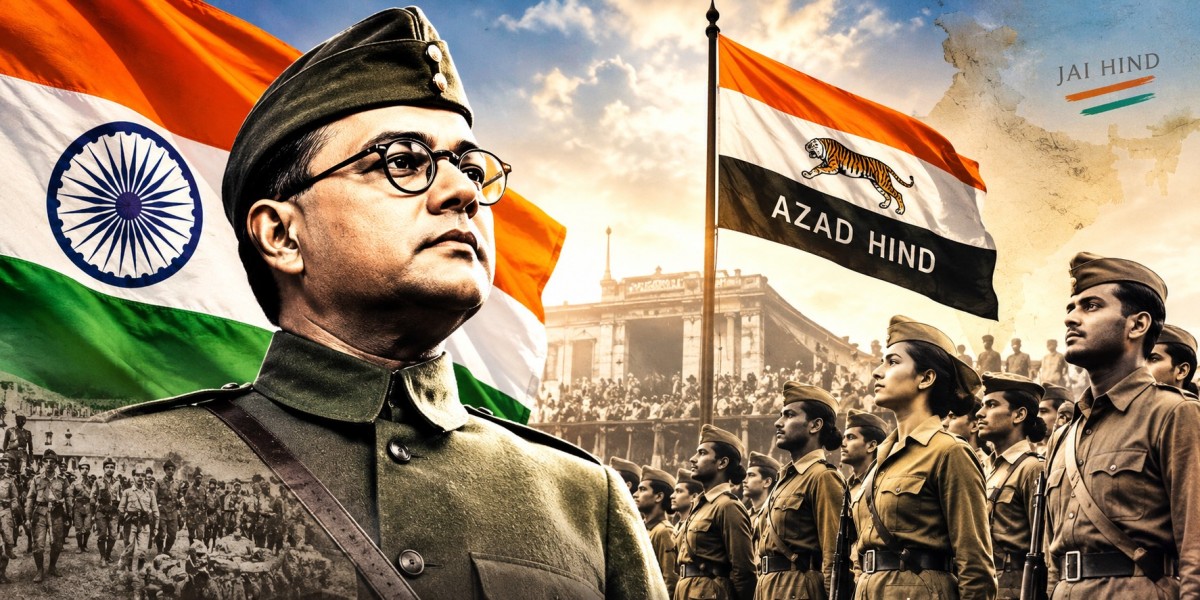
Azad Hind Government Formation Day 2026: India remembers one of the most significant milestones in its freedom struggle on October 21. On this day in 1943, freedom fighter Netaji Subhas Chandra Bose announced the establishment of the Provisional Government of Free India, popularly known as the Azad Hind Government, in Singapore. This historic declaration gave a political identity to the overseas Indian independence movement and strengthened the struggle against British colonial rule. 🇮🇳
The formation of the Azad Hind Government reflected Netaji’s determination to achieve complete independence for India. His leadership, the contributions of the Indian National Army (INA), and the support of Indians living across Southeast Asia made this movement an important chapter in the history of India’s independence.
Also Read: Brazilian Model Larissa Responds to Allegations of Rahul Gandhi’s Vote Chori Connection
📅 Why Do We Celebrate Azad Hind Government Formation Day?
India observes October 21 to remember the establishment of the Provisional Government of Azad Hind in 1943. The day highlights Netaji Subhas Chandra Bose’s vision of a free India and his efforts to organise Indians outside the country for the independence movement.
Unlike movements that relied primarily on political negotiations and non-violent resistance, Bose pursued an armed struggle against British rule. He sought international support, mobilised overseas Indian communities and worked to establish a government that could represent India’s aspirations for sovereignty.
The occasion encourages people to learn about the different approaches, sacrifices and contributions that shaped India’s long struggle for freedom.
🏛️ The Formation of the Azad Hind Government in 1943
On October 21, 1943, Netaji Subhas Chandra Bose announced the formation of the Provisional Government of Free India at the Cathay Theatre in Singapore. At the time, Japanese forces occupied Singapore during the Second World War.
Bose established the government with the support of the Indian Independence League and Indian nationalists living in Southeast Asia. He served as its Head of State, Prime Minister and Minister of War, taking responsibility for its political and military direction.
The government aimed to organise the independence movement, secure international recognition and coordinate the struggle to end British rule. It also sought to establish a permanent national government after India achieved independence.
The establishment of Azad Hind marked an important attempt to give the independence movement a formal political structure outside British-controlled India. 🇮🇳
👨✈️ Who Was Netaji Subhas Chandra Bose?
Netaji Subhas Chandra Bose was one of India’s most prominent freedom fighters. Born on January 23, 1897, in Cuttack, Odisha, he developed a strong commitment to India’s independence from an early age.
Bose joined the Indian National Congress and eventually became its president. However, differences over strategy and the pace of the independence movement led him to pursue a separate course.
During the Second World War, he travelled abroad to seek international assistance for India’s liberation. He eventually reached Southeast Asia, where he took leadership of the Indian National Army and established the Azad Hind Government.
Bose believed that India needed complete independence and that Indians should organise themselves with determination and discipline to achieve it. His leadership and uncompromising opposition to colonial rule continue to shape his place in India’s national memory.
The Role of the Indian National Army (INA)
The Indian National Army, also known as the Azad Hind Fauj, played a central role in Netaji’s campaign for independence.
The INA originated in 1942 under the leadership of Mohan Singh and was subsequently reorganised under Bose in Southeast Asia in 1943. Bose worked to expand its strength, improve its organisation and inspire Indian soldiers and civilians to support the cause of freedom.
The army included Indian prisoners of war and volunteers who wanted to fight British rule. Overseas Indian communities also contributed money, jewellery, supplies and other resources to support the movement.
The INA conducted military operations alongside Japanese forces during the Second World War, including campaigns on the northeastern frontier of British India. Although it could not achieve its military objective, its activities and the subsequent trials of INA officers helped intensify public debate about colonial rule and loyalty within the armed forces.
The INA remains an important part of the broader history of India’s independence struggle. 🫡
🌏 International Recognition and the Government’s Objectives
The Azad Hind Government sought recognition from foreign governments and aimed to establish itself as the representative authority of an independent India.
Several Axis-aligned governments recognised it during the Second World War. Japan played a major role in supporting the government and the INA, although this relationship also placed the movement within the wider geopolitical and military interests of wartime Japan.
The government sought to mobilise Indians abroad, coordinate military action against British forces and prepare for the establishment of an independent national government.
Its existence demonstrated Bose’s effort to take India’s independence question onto the international stage. However, the government operated in exile, depended heavily on Japanese support and did not exercise independent control over most of India.
🚩 The Connection Between Azad Hind and the Andaman and Nicobar Islands
The Andaman and Nicobar Islands became an important part of the Azad Hind Government’s history during the Second World War.
In December 1943, Japanese authorities transferred nominal administrative control of the Japanese-occupied islands to the Azad Hind Government. Bose visited the islands and renamed them Shaheed and Swaraj, symbolising sacrifice and self-rule.
The transfer represented a significant symbolic development for the movement. However, Japanese forces retained substantial control over the islands, limiting the government’s actual administrative authority.
Despite these limitations, the event strengthened the Azad Hind Government’s claim that it was working towards the establishment of an independent Indian state.
👩✈️ Women’s Contribution to the Freedom Movement
Women played an important role in the Azad Hind movement, particularly through the Rani of Jhansi Regiment of the Indian National Army.
Led by Captain Lakshmi Swaminathan, later known as Lakshmi Sahgal, the regiment brought together women volunteers who wanted to participate directly in the struggle against British rule.
The regiment drew inspiration from Rani Lakshmibai of Jhansi, the celebrated warrior queen who fought against British forces during the uprising of 1857.
Its formation challenged conventional expectations about women’s roles in military and public life. The regiment remains an important example of women’s participation in India’s freedom movement and Netaji’s efforts to mobilise people across different sections of society. 💪
🗣️ Netaji’s Inspiring Message to Indians
Netaji Subhas Chandra Bose used powerful speeches and slogans to motivate Indians to work towards independence.
His famous call, “Give me blood, and I shall give you freedom!”, became closely associated with his appeal for sacrifice and commitment to the independence movement.
The INA also adopted the marching song “Kadam Kadam Badhaye Ja,” which became a symbol of courage, discipline and determination.
Another slogan closely associated with Bose and the INA was “Chalo Delhi,” reflecting their objective of advancing towards India’s capital and ending British rule.
These messages helped build solidarity among supporters of the movement and continue to feature prominently in discussions of Netaji’s legacy.
⚔️ Why the Azad Hind Government Was Historically Significant
The Azad Hind Government was significant because it attempted to translate the demand for independence into a formal political and military programme.
Its importance extends beyond its limited territorial control and eventual military defeat. The government mobilised overseas Indians, sought international recognition and gave the INA a political framework for its campaign.
The INA’s military operations did not independently secure India’s freedom. However, the movement and the trials of its officers generated considerable public attention and nationalist sentiment in the final years of British rule.
Historians examine the INA alongside other major factors in India’s independence, including mass movements, political negotiations, revolutionary activities, wartime developments and changes within the British Empire.
The Azad Hind Government therefore occupies a distinctive place in the complex history of India’s struggle for independence.
🕊️ The Legacy of Netaji Subhas Chandra Bose
Netaji’s legacy continues to inspire discussions about patriotism, leadership, courage and national responsibility. His determination to pursue complete independence made him a prominent figure in India’s freedom struggle.
The Azad Hind Government also highlights the contributions of Indians living abroad, whose financial support, volunteer service and participation helped sustain the movement.
Remembering this chapter allows younger generations to understand that India’s independence emerged from the combined efforts of people who followed different strategies and made significant sacrifices.
It also encourages a balanced understanding of the historical circumstances in which Bose and the INA operated, including the complexities of their wartime alliance with Japan.
🇮🇳 How Can We Honour Azad Hind Government Formation Day?
People can commemorate the occasion in several meaningful ways:
- 📚 Learn about history: Read reliable accounts of Netaji, the Azad Hind Government and the Indian National Army.
- 🏫 Organise educational programmes: Schools and colleges can conduct discussions, quizzes, speeches and history exhibitions.
- 🎖️ Remember freedom fighters: Recognise the contributions of soldiers, women volunteers and overseas Indian communities.
- 🗣️ Share historical knowledge: Encourage informed conversations about India’s independence movement.
- 🤝 Practise responsible citizenship: Promote unity, equality, public service and respect for India’s diverse communities.
These activities can help preserve historical awareness and encourage future generations to appreciate the sacrifices associated with India’s freedom struggle.
🌟 Conclusion: Remembering a Historic Chapter in India’s Independence
Azad Hind Government Formation Day commemorates Netaji Subhas Chandra Bose’s historic announcement on October 21, 1943, in Singapore. By establishing the Provisional Government of Free India, Bose sought to give political direction and international visibility to the struggle against British colonial rule.
Although the government faced significant military and political limitations, its formation, the activities of the Indian National Army and the contributions of overseas Indian communities became important parts of India’s independence story.
As India remembers this historic day in 2026, Netaji’s legacy offers an opportunity to reflect on the courage, determination and diverse efforts that shaped the nation’s journey towards freedom.
Jai Hind!
Also Read: Sharad Purnima 2026: Why Devotees Prepare Kheer Under the Full Moon